Categories
Uncategorized

Web design for small business: Boost local leads with a pro site

Let's be honest: a good website is your hardest-working employee. It’s the one that never sleeps, never takes a smoko break, and is constantly out there finding new jobs for you, 24/7. For Kiwi tradies, a professional website isn't just a nice-to-have; it's your digital front door, working tirelessly to find customers, showcase your quality workmanship, and keep the phone ringing.

Why Your Website Is Your Most Valuable Employee

Long gone are the days of just chucking an ad in the local paper and waiting for a call. Today, when a homeowner in Ponsonby needs a plumber or a developer in Christchurch is after a reliable builder, the first thing they do is pull out their phone and search online.

Your website is often the very first handshake a potential customer has with your business. It's where they check out your past work, get a feel for your professionalism, and decide whether you're the right tradie for the job. A well-built site isn't some technical headache; it's a genuine business asset that builds trust and brings in consistent work.

It's More Than Just a Digital Brochure

It's helpful to stop thinking of your website as a static flyer and start seeing it as an active tool. Its main job is to turn a curious visitor into a paying customer. This is especially true in New Zealand's crowded market, where standing out is essential for success.

Cartoon worker on laptop, houses, toolbox, and 24/7 support for home service management.

Recent numbers show a significant jump in new small businesses starting up across the country, with the monthly average hitting 5,160 in 2025. This increase naturally means more competition for everyone. With nearly half of all Kiwi small businesses already online, simply having a website doesn’t cut it anymore. It needs to perform for you.

Built for Performance and Reliability

To make sure your site is always online and ready to greet new customers, you need a solid foundation. This includes reliable hosting that keeps your site fast, secure, and available, even when you're flat-out on the tools. A dependable online presence reassures customers that you are a professional and stable operation.

A great website for a tradie does three things really, really well: it clearly shows what you do, proves you're bloody good at it with photos and reviews, and makes it dead simple for a customer to get in touch.

This guide will walk you through exactly how to get a professional website that does all that. We’ll cover everything from the must-have pages to getting found by local customers on Google. It’s more straightforward than you might think, and the payoff is an online tool that consistently wins you more work.

Right, let's get into it.

Building Your Website's Core Pages

A great website for a Kiwi tradie is a bit like a well-organised tool trailer. Everything has its place, making it dead easy for you to find what you need to get the job done. For a customer landing on your site, that same logic applies. They need clear, simple navigation to find information quickly, which is what turns their initial interest into an actual phone call.

You don't need a massive, complicated website. In fact, keeping it simple is almost always better. The most successful trade business websites are typically built around five core pages that work together to pull in and win over new customers.

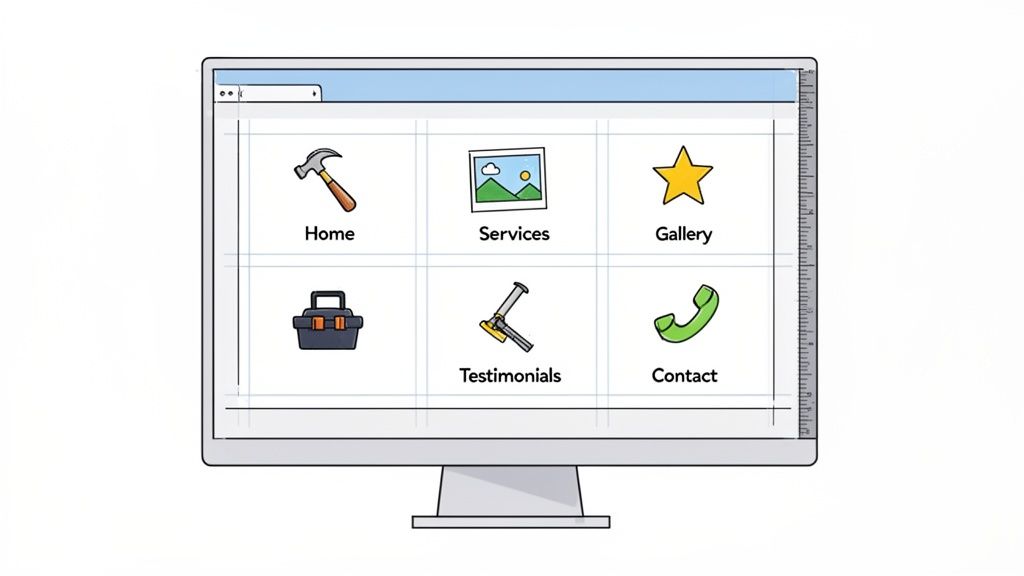
A minimalist navigation menu featuring icons for Home, Services, About, Projects, and Contact sections.

This simple structure gives potential clients a clear path to follow. It guides them smoothly from their first look right through to making that all-important enquiry.

The Five Must-Have Pages for Your Website

Let's break down the essential pages that form the backbone of any good web design for small business owners in the trades. Each one has a specific job to do in building trust and bringing in leads.

  • Homepage: Think of this as your digital front door. It’s the first impression most visitors will get, so it needs to instantly answer three questions: who you are, what you do, and where you work. A strong headline, a clear call to action (like "Get a Free Quote"), and top-notch photos of your work are non-negotiable here.

  • Services Page: This is where you get into the nitty-gritty of how you can solve your customers' problems. Don't just list your skills. Instead, think about the actual jobs people are searching for. For instance, a plumber might have sections for 'Emergency Leak Repairs,' 'Hot Water Cylinder Installation,' and 'Drain Unblocking.' This approach helps both customers and Google understand exactly what you’re an expert in.

  • About Us Page: People hire tradies they feel they can trust. This page is your chance to tell your story, introduce the team, and explain why your business is the reliable choice. Mentioning your years of experience, qualifications, or your commitment to quality workmanship goes a long way in building that connection and demonstrating your expertise.

  • Projects or Gallery Page: Nothing sells your work like seeing your work. This is your digital portfolio, showing off the quality of your craftsmanship. High-resolution photos of completed jobs are one of the most powerful tools you have. Before-and-after shots are especially brilliant for builders, painters, and landscapers as they provide clear evidence of your skill.

  • Contact Page: When a customer decides to get in touch, you need to make it incredibly easy for them. This page must have your phone number, email address, a simple contact form, and your service area. Listing the main suburbs you cover is also a great little trick to help your local search rankings.

A well-structured website acts as your silent salesperson. It anticipates a customer's questions and provides clear, reassuring answers, smoothly guiding them towards picking up the phone.

Making Navigation Simple and Intuitive

How you link these pages together is just as important as what's on them. Your navigation needs to be simple and logical, so visitors can get around your site without becoming frustrated. A clean menu sitting at the top of every page with links to your core sections is standard for a reason—it just works.

A confusing website is a guaranteed way to lose a potential job. If someone can't find your services or contact details in a few seconds, they'll hit the back button and click on your competitor’s site without a second thought. This is where good user experience comes in, and you can learn more about how a professional user interface helps convert visitors in our detailed guide.

At the end of the day, every page on your website should have one clear goal. The Homepage grabs attention, the Services page informs, the About page builds trust, the Projects page proves your skill, and the Contact page seals the deal. Nail these core elements, and you'll have a powerful online tool that works around the clock to bring you more business.

Ensuring Your Site Works Perfectly on Mobile

Picture this: a potential customer has a burst pipe and they're frantically searching for a plumber on their phone while standing in a puddle. This is exactly how most of your customers will find you—on the go, with an urgent problem that needs fixing now.

That’s why having a website that works flawlessly on a mobile phone isn't just a nice-to-have feature; it’s absolutely critical for getting jobs.

Think of it like this: your website should be like water, adapting perfectly to any container it's poured into. It needs to look just as good and be just as easy to use on a massive desktop screen in an office as it is on a tablet or a smartphone out on a job site. This is what we call mobile-responsive design, and it’s a complete non-negotiable for any serious trade business.

A website that’s slow, hard to read, or has buttons too small to tap on a mobile will send a potential customer straight to your competition. In those urgent moments, people don't have the patience to wrestle with a clunky site. They'll just hit the 'back' button and find a tradie whose website makes their life easier.

An illustration showing a responsive website adapting across a smartphone, tablet, and laptop, indicating mobile-friendly design and fast performance.

Why Speed and Usability Matter on Mobile

It’s not just about looking good. How your website actually performs on a mobile has a direct impact on your bottom line. Google pays very close attention to how people experience your site, especially on their phones, and it rewards fast, user-friendly sites with better rankings in search results.

This means a mobile-optimised site is far more likely to appear at the top when someone searches for "emergency electrician in Auckland" or "builder in Christchurch". For tradies in New Zealand, this is everything. You rely on local customers finding you quickly, and poor performance on a phone is like having a hole in your bucket—you're just leaking potential jobs.

Google's own metrics, called Core Web Vitals, measure things like loading speed and how stable the page is, and these are now direct ranking factors. You can get more insights on why mobile performance is so crucial for Kiwi businesses in this 2026 website performance report.

The simple truth is this: a fast, mobile-friendly website keeps potential customers on your page and makes it dead easy for them to call you. A slow one actively drives them away.

Key Features of a Mobile-Optimised Website

So, what does a great mobile experience actually look like for a tradie's website? It really just comes down to a few key elements that make sure your site is built to get you business, no matter what device a customer is using.

Here's a quick checklist of the must-haves for a solid mobile website.

Feature Why It Matters for Your Trade Business
Fast Loading Times Pages must load in under 3 seconds. Any longer, and you lose them. This comes from optimised images, clean code, and good hosting.
Click-to-Call Buttons Let customers tap a button on their screen and call you directly. It's the fastest way to turn a website visitor into a paying job.
Readable Text No one wants to pinch and zoom to read about your services. Text needs to be big enough to read easily on a small screen.
Simple Navigation A tidy, easy-to-use menu is essential. A simple "hamburger" icon (three lines) that opens up your main pages works perfectly.

Getting these features right means your site is ready to capture leads from customers on the go, which is where most of your urgent, high-value work comes from. The good news is you don't need to be a tech whiz to get this right. Modern, professional website design handles all of this automatically. When you work with a team that gets the trades, we build your site from the ground up to be fully responsive, ensuring you can be confident it’s always ready to capture leads, wherever your customers might be.

How Local Customers Find You with SEO

SEO, or Search Engine Optimisation, sounds a bit technical, but its job is dead simple: to get your business in front of local customers right when they’re searching on Google for the exact work you do.

Think of it this way. SEO is how you let Google know you’re the go-to builder in Tauranga or the most trusted sparky in Hamilton. When you get it right, your website is the first one a homeowner sees when they’ve got a problem that needs solving.

This isn't about pulling a fast one on Google. For a tradie, good SEO is all about putting clear, helpful information on your website that answers your customers' questions. Do that, and your site starts bringing in a steady stream of local enquiries, meaning you can spend less on ads and more time on the tools.

Connecting with Customers in Your Service Area

One of the most powerful things you can do for your business is to spell out exactly which areas you serve. This is a massive clue for Google. If someone in Napier searches for "roof repair," Google’s job is to show them a local roofer, not someone based hours away in Auckland.

Simply listing the suburbs you cover on your Services or Contact page helps Google connect the dots. A clear line like, “Proudly serving Hastings, Havelock North, and the wider Hawke’s Bay region” makes a huge difference. It tells both potential customers and search engines exactly where you’re ready to work.

This local focus is everything. Google is getting smarter, prioritising businesses that are genuinely relevant and trusted in their community. For Kiwi tradies, this means your web design for small business needs to be built around the way locals search—think phrases like 'Auckland plumber near me'. This is how you build the authority needed to rank at the top.

Your Google Business Profile Is Your Digital Billboard

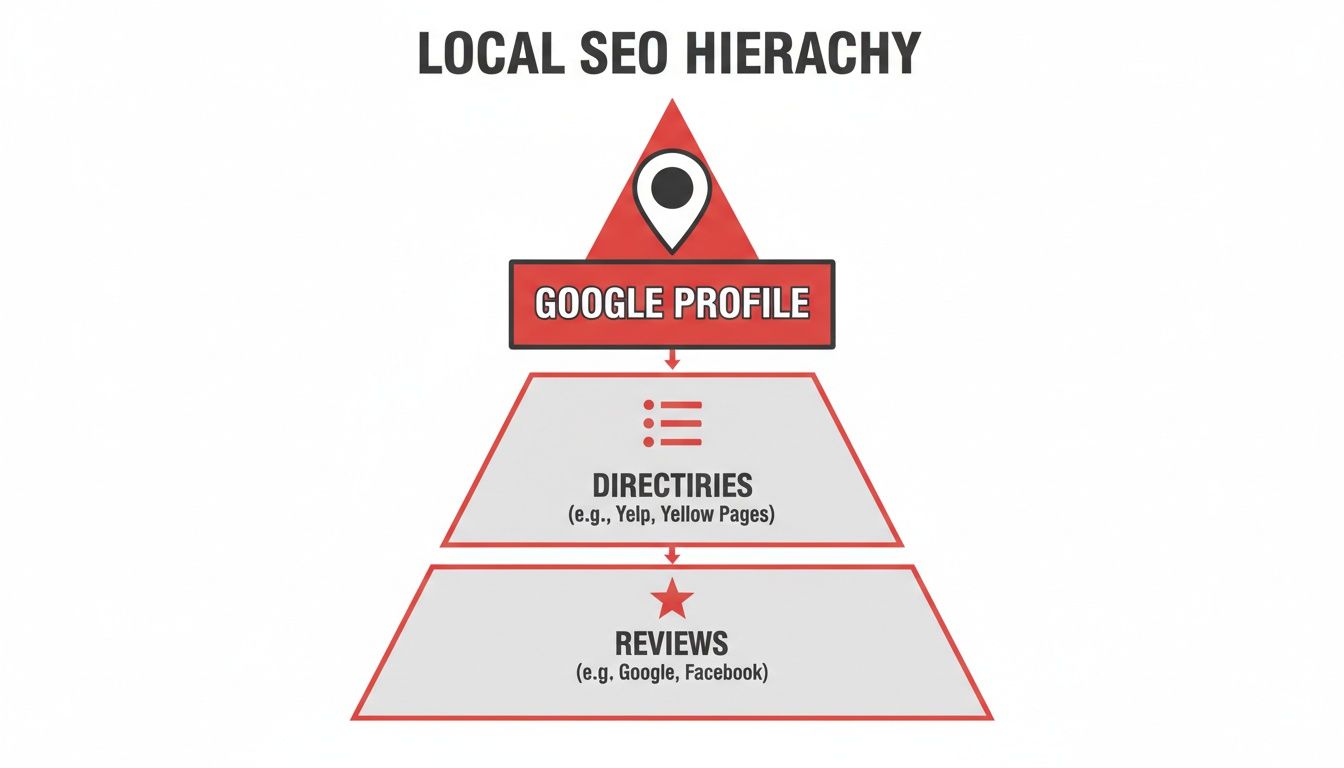
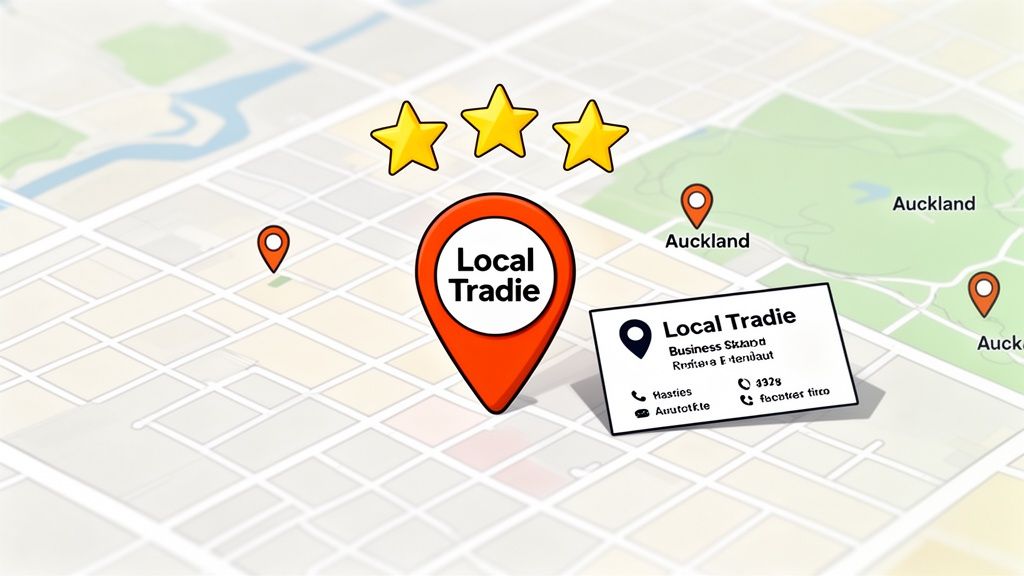
If you only do one thing for your local SEO, make it this: claim and complete your Google Business Profile. It’s a completely free tool, and it’s basically your digital billboard, putting all your key info right there on Google Search and Google Maps.

Your profile shows customers:

  • Business Name, Address, and Phone Number: The absolute essentials for getting in touch.
  • Opening Hours: So people know when they can call you.
  • Customer Reviews: This is huge. It’s instant social proof that you do great work.
  • Photos of Your Work: A chance to show off your quality craftsmanship.

A complete and active Google Business Profile is probably the single most important marketing tool for a local trade business. It’s often the very first impression a customer will have of you.

Make a habit of keeping this profile up-to-date and, just as importantly, ask your happy customers to leave you a review. It’s often the quickest way to start showing up for local searches, sometimes even before your website starts climbing the ranks.

The Power of Genuine Customer Reviews

Speaking of reviews, they are pure gold. They don’t just signal to Google that you’re a legitimate, trusted local business; they have a massive impact on potential customers. When someone’s deciding between two or three tradies, a string of positive reviews from other locals can be the deciding factor.

Build it into your process. Once a job is done and the customer is happy, send a quick email or text with a direct link to your Google profile asking for a review. Every new piece of feedback strengthens your reputation and gives your local visibility a boost. If you're keen to go deeper, check out our guide on SEO services for New Zealand businesses.

By focusing on these straightforward local SEO tactics, your website becomes much more than an online brochure. It turns into a consistent, lead-generating machine that keeps your phone ringing with the right kind of local jobs.

DIY Website Or Professional Agency? Let's Break It Down

So, you need a website. You've hit your first major crossroad: do you roll up your sleeves and go the DIY route with something like Squarespace or Wix, or do you call in the pros? Both paths will get you a website, but believe me, the journey and the final destination are completely different.

On the surface, building it yourself looks like a bargain. The low monthly fees are tempting, and they make it sound like you can knock out a professional-looking site over a weekend. For any tradie watching the budget, it seems like a no-brainer.

But here’s the thing they don't advertise – the massive hidden cost is your own time. Every hour you sink into learning their system, fiddling with a template that won’t cooperate, or trying to fix a weird glitch is an hour you’re not on the tools, quoting jobs, or actually running your business. That time adds up, fast.

The Real Price of a "Cheap" Website

Putting together a website that actually gets your phone ringing is a lot more than just dragging a few photos onto a page. A good-looking site is one thing, but a site that brings in leads needs a solid strategy from the very beginning.

This is where DIY platforms start to show their cracks. You can easily end up with a site that looks half-decent but is painfully slow on a mobile, a nightmare for customers to navigate, or completely invisible to Google when someone in your town is searching for your services. Trying to patch these problems later is a headache, and you’re stuck with an online business card that isn’t doing any of the heavy lifting.

An effective website isn’t just an online brochure. It’s a purpose-built machine designed to attract local customers and turn them into paying jobs. That requires a specific set of skills that go way beyond basic design.

The Pay-Off of Bringing in a Specialist

Investing in a professional agency, especially one that gets the trades, is about more than just paying someone to build a website. It’s an investment in a crucial business asset. You’re partnering with experts who know exactly how to make your website work for you, handling everything so you can stick to what you do best.

Here’s what a specialist agency brings to the table:

  • Designs That Work for Tradies: We know what a potential customer needs to see on a plumber’s or electrician's site to trust you enough to make the call.
  • Local SEO from the Ground Up: We build your site from day one so that it shows up when locals are searching for your services. No point having a great site if no one can find it.
  • Guaranteed Performance: We make sure your site is fast, secure, and looks great on a mobile phone – which is where most of your customers will be looking.
  • Real Support: Got a question? Need an update? You’ve got a team to call. You’re not left alone to watch tutorial videos when something goes wrong.

This approach saves you dozens of hours and the frustration of trying to be your own web developer. Yes, the upfront cost is higher than a DIY subscription, but the return on investment comes from a reliable stream of good-quality leads and more time for you to focus on billable work. Wondering what goes into the cost? We break it all down in our guide to professional web design pricing.

To help you see it all laid out, here's a direct comparison.

Comparing Website Options: DIY vs Professional Agency

Factor DIY Website Builder Professional Agency (Trades Online)
Upfront Cost Low monthly subscription. Higher one-time investment.
Time Investment High. You do all the work: design, writing, setup, and troubleshooting. Minimal. We handle everything, letting you focus on your business.
Expertise Required You need to learn design, copywriting, SEO, and technical setup. None. You're hiring our expertise in all these areas.
Lead Generation Unlikely. Not optimised for local search or converting visitors. The primary goal. Built from the ground up to attract and convert local customers.
Mobile Performance Can be hit-or-miss. Templates often look clunky on phones. Guaranteed. Professionally optimised for a seamless mobile experience.
Ongoing Support Limited to platform help-desks or forums. You're on your own. Dedicated, personal support from our team for any updates or issues.
Final Result Often a basic, generic-looking site that doesn't generate work. A professional, custom-built asset that actively grows your business.

Ultimately, the choice comes down to what you value more. A DIY site might save a bit of cash upfront, but a professionally built website saves you time and is far more likely to deliver the results that actually grow your business. For most busy Kiwi tradies, that makes the decision pretty straightforward.

Your Next Steps to Winning More Work Online

We've covered a lot of ground, showing how a great website isn't just an online brochure—it's a hard-working tool that can bring in a steady stream of local jobs for your trade business. It needs to look the part, work a treat on a mobile, and actually get found by Kiwis looking for a pro.

So, what's next? It’s time to take what you’ve learned and put it into practice.

Taking that first step doesn't have to be a massive headache. We know you’re flat out on the tools, so we’ve made our process as simple and stress-free as possible. It all starts with figuring out exactly where you're at right now and what the real opportunities are for your business.

This flowchart breaks down the two main paths a tradie can take: giving it a go yourself or bringing in the experts.

Flowchart comparing two website options: DIY (Do It Yourself) and Agency (Professional Help) with their characteristics.

As you can see, the path you choose makes a huge difference to the time you'll spend and the results you'll get. That’s why getting this first step right is so important.

Get a Clear Plan of Attack

The best way to move forward is with an honest look at where you stand online right now. That’s why we offer a completely free, no-strings-attached website assessment. It’s the perfect starting point.

Our ‘Is your website leaking leads?’ audit is built specifically for tradies. We’ll pop the bonnet on your current site (or your plans for one) and give you a straight-up, practical plan that actually makes sense for your business. No sales pitch, just a clear, professional opinion.

A great website is a system that works for you, not another job you have to manage. The goal is to get your online presence working as hard as you do, bringing in steady work so you can focus on your trade.

This audit gives you the clarity you need to make a smart decision about your web design for small business. If you're really keen to turn your site into a customer-magnet, you could even explore how a lead generation chatbot can help you capture enquiries 24/7.

Let's Have a Chat

The next move is simple. Let's have a quick, down-to-earth chat about where you want to take your business. We want to hear what kind of jobs you’re chasing and what a successful year looks like for you. From there, we can figure out a plan to get you there.

Ready to get the ball rolling?

Book your free website audit today and let’s get a plan in place to win you more work. It’s that easy.

Your Questions, Answered

Jumping into getting a professional website can feel like a big leap, so it's only natural you've got questions. We chat with Kiwi tradies every day, and the same queries tend to pop up. Here are some straight-up answers to give you a clearer picture.

What’s a New Website Going to Cost Me?

This is always the first question, and the honest answer is: it depends. The cost of a professional web design for small business really comes down to what you need it to do. A straightforward, effective five-page site will obviously be a smaller investment than a complex one packed with custom features.

Think of it like quoting a job – a small bathroom reno isn't going to be the same price as a full-scale new build. We're big believers in clear, upfront pricing with no nasty surprises. You'll know exactly what you’re getting for your money before we even start.

How Long Will It Take to Get Live?

Time is money, especially when you're on the tools all day. A good agency can typically get a high-quality, lead-generating website for a trade business up and running in about 4 to 6 weeks.

That timeframe gives us enough room for proper planning, design, getting the words right, and testing everything to make sure it all works perfectly the moment it goes live. It’s a far cry from spending months of your own precious time wrestling with a DIY site on your nights and weekends.

A great website isn't just another bill to pay—it's an investment in a system that brings you more work. The whole point is to get a return on it by getting more calls, sending more quotes, and booking more jobs.

Can I Make Changes to the Site Myself?

You bet. We build our sites on easy-to-use platforms, so you can jump in and make simple updates whenever you like. Adding new photos to your portfolio or tweaking the text on a service page is definitely something you can handle yourself.

But we also know you're flat-out running your business. That’s why we offer ongoing support packages. If you'd rather just flick us an email with the updates and have us sort it, we're here to help. It lets you get on with looking after your customers.

What Results Should I Actually Expect?

Look, a new website isn't a magic wand that makes your phone ring off the hook overnight. Building a solid online presence takes a bit of time. In the first few months, you should start seeing your site show up in local Google searches and begin to get a steady trickle of new enquiries.

Over time, as we work on your local SEO and you gather more great customer reviews, that trickle starts to become a reliable stream of quality leads. The end goal is to build an asset for your business that consistently brings in work, so you're not just relying on word-of-mouth and have more control over your growth.


Ready for a website that works as hard as you do? The team at Trades Online is here to make the whole process dead simple and effective. Let's kick things off with a no-obligation chat about where you want to take your business.

Book your free website audit today and we'll show you exactly how we can help you win more work.

Categories
Uncategorized

Choosing a New Zealand SEO Agency That Wins You More Jobs

Picking the right New Zealand SEO agency is a significant decision for your trade business. It’s not about getting bogged down in confusing reports and technical jargon; it’s about one thing—making your phone ring with local customers who need a reliable tradie, right now. This guide will walk you through finding a partner who genuinely understands what you do and can help you win more jobs.

Why the Right SEO Partner Is a Tradie's Best Mate

Let's cut to the chase. You're a professional on the tools, not a guru on Google's ever-changing algorithms. But these days, how you appear online is just as important as the quality of your work. If a homeowner with a burst pipe cannot find you on their phone, you are practically invisible.

Search Engine Optimisation (SEO) is simply the process of getting your website seen by people who are actively searching for your skills. It is about being the first name that pops up when someone in your service area searches for "emergency plumber in Wellington" or "builder for a renovation in Auckland."

Connecting with Customers When They Need You Most

Picture this: it’s a rainy Tuesday night in Christchurch, and a pipe bursts under someone's kitchen sink. What do they do? They grab their phone and search for help. They are not just browsing; they have a problem and they need it fixed, fast.

Good SEO is what puts your business front and centre at that exact moment. It is not some dark art; it is a smart, reliable strategy for getting in front of motivated customers who are ready to hire someone. This consistent online presence builds trust and makes your business the easy choice.

Making Sure You're Visible Where It Counts

Here in New Zealand, Google completely dominates the scene, holding a massive 92.66% of the search engine market share. That means for us tradies, over nine out of ten potential customers are scrolling through Google results when the power goes out or a roof starts leaking. You can dig into more of these NZ search stats over at Applabx.

If you do not have a solid presence online, you are missing out on a huge slice of the pie. Every call you do not receive is a job that went straight to a competitor who was easier to find.

Think of a great SEO partner as an extension of your crew. Their job is not just to get you to the top of Google; it is to get your phone ringing with real, qualified leads so you can focus on the tools, not the marketing.

It's About More Than Just Rankings

A proper SEO agency does a lot more than just fiddle with your website. They understand the unique challenges and opportunities for Kiwi tradies.

They know that a call for a plumber is often an emergency, while a quote for a builder might be part of a much longer decision-making process. This kind of insight is crucial for building a strategy that brings in the right kind of customers for your specific trade.

An experienced partner will focus on:

  • Local Visibility: Making sure you appear for searches in the specific suburbs and towns you actually service.
  • Lead Quality: Attracting customers who need the jobs you want to do, which means less time wasted on tyre-kickers.
  • Building Trust: Using your website to showcase your qualifications, quality workmanship, and customer reviews to build confidence before they even call you.

Ultimately, putting money into the right New Zealand SEO agency is an investment in the long-term health and growth of your business. It is about building a steady, reliable flow of work so you can spend less time wondering where the next job is coming from and more time doing what you do best.

Ready to see how we can help fill your calendar? Get in touch for a no-obligation chat about your business goals.

What a Top-Notch Tradie SEO Agency Looks Like

Finding the right SEO partner can feel like a bit of a lucky dip, but it does not have to be. Let's be honest, not all agencies are created equal, and the ones that get the best results for tradies have a very specific set of skills. They understand your world.

When you are vetting a New Zealand SEO agency, you need to cut through the sales talk. A top-notch partner understands that for a builder, plumber, or sparky, a "lead" is not just a number. It is an urgent call-out, a serious quote request, or a job that keeps your crew busy next week.

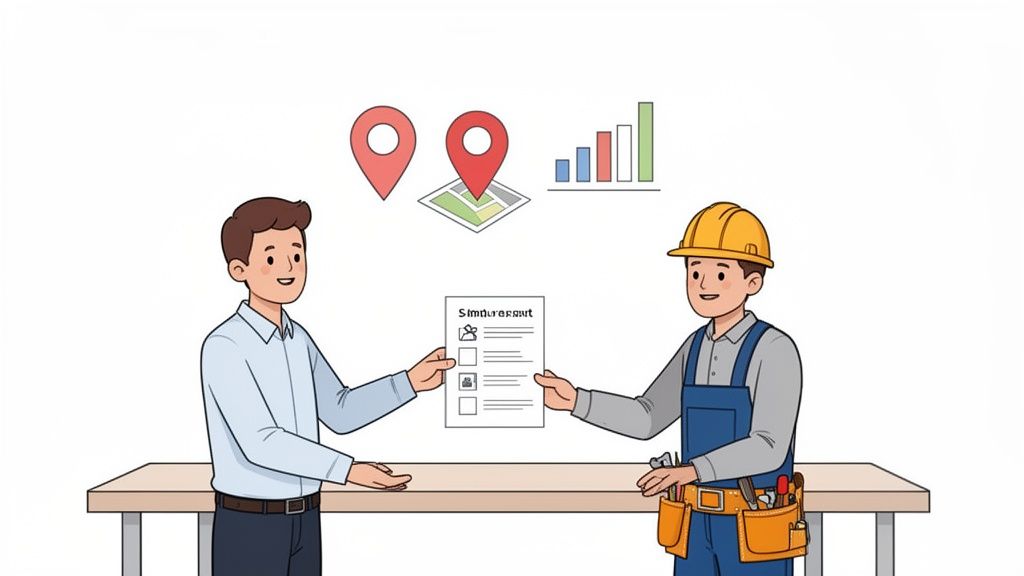
Businessman and worker with hard hat exchange document, with map and bar chart icons.

They Live and Breathe Local SEO

For a tradie, ranking nationally is pretty much useless. You need to be found by customers in the specific suburbs and towns you actually service. A specialist agency makes local SEO its bread and butter, focusing on the nitty-gritty tactics that get you seen by homeowners down the road, not someone on the other side of the country.

This means they have a rock-solid process for things like:

  • Dialling in Your Google Business Profile: This is your digital shopfront. They will ensure it is fully kitted out with the right service areas, hours, phone number, photos of your best work, and a steady stream of good reviews.
  • Building Local Citations: They get your business name, address, and phone number listed consistently across relevant online directories. This is a massive trust signal for Google that proves you are a legitimate local operation.
  • Targeting Hyper-Local Keywords: They know how to find the exact search terms people are typing in, like "emergency plumber Johnsonville" or "roofer North Shore," and weave them into your website.

A sharp SEO agency also understands how to master automated keyword research for SEO success, which helps them pinpoint the most valuable search terms right from the get-go.

They Talk Straight and Show You the Proof

You should not need a marketing degree to figure out what your SEO agency is up to. A great partner cuts the jargon and talks to you in plain English. Their reports should be simple, clear, and focused on what actually matters to your business.

A good agency report should not be a confusing wall of graphs. It should clearly answer one question: "Did we get more qualified leads this month than last month?"

They will track the important stuff: phone calls from the website, quote requests through your contact form, and your rankings for those money-making local keywords. This transparency builds trust and shows you exactly what your investment is delivering. It is also why having a well-designed website is crucial; a great user experience turns visitors into customers. If you are wondering how to improve this, a UI/UX design consultant can make a world of difference.

They Have Real-World Experience with Kiwi Tradies

An agency that claims to have "experience with tradies" needs to prove it. Ask for case studies. They should understand the seasonal swings in your work, the types of jobs you are after (and the ones you are not), and the way your customers talk.

This industry knowledge is gold. It means they will not waste your time or budget chasing irrelevant keywords or leads from outside your service area. They understand that your main goal is to fill the schedule with profitable jobs, and they build their entire strategy around that single objective.


To help you size up potential agencies, here is a quick checklist of what to look for. Think of it as your "good bloke" test for SEO partners.

Key Qualities of a Tradie-Focused SEO Agency

Essential Quality What It Looks Like in Practice Why It Matters for Your Business
Industry Fluency They use terms like "call-out fee" and "quote" correctly. They understand your ideal job types. They can create content and ads that speak directly to your customers, attracting the right kind of work.
Local SEO Obsession Their strategy is built around your Google Business Profile, local keywords, and service area pages. You get found by customers in your immediate area who are ready to hire, not tyre-kickers from another city.
No-Nonsense Reporting Reports focus on leads, calls, and form submissions, not just "traffic" or "impressions." You see a clear connection between your marketing spend and actual, measurable business growth.
Proven Track Record They can show you case studies or examples of other Kiwi tradies they've helped succeed. You have confidence they are not just guessing. They have a proven system for getting results in your industry.
Clear Communication They explain their process in plain English and are easy to get a hold of for a chat. You feel like you have a true partner, not just another supplier. You are always in the loop.

Ultimately, the right agency feels like an extension of your own team. They take the time to learn your business, they are easy to reach, and they are genuinely invested in helping you grow. When you find that, you can get back to what you do best, confident that your online marketing is in safe hands.

2. Decoding SEO Costs and Your Investment

Right, let's get down to brass tacks: money. When you start looking for a New Zealand SEO agency, one of your first questions is going to be, "What's this going to set me back?" It is a perfectly good question, and the answer can feel a bit all over the shop.

The key is to understand what you are actually paying for. SEO is not like buying a new ute; it is an ongoing investment that builds real value over time. Think of it like hiring a superstar apprentice who works 24/7 to line up new jobs for your business. The goal is straightforward: reach a point where the service easily pays for itself through the new work it brings in.

What Does SEO Typically Cost in New Zealand?

Look, there is no single price tag for SEO. The amount you will need to invest usually comes down to how competitive your trade is in your local area. For instance, getting a builder to rank well in Auckland is a much bigger battle than ranking a landscaper in a small town. The price will reflect that fight.

Recent figures show SEO costs in New Zealand are definitely climbing. A basic package from a decent agency might start around $500 to $1,500 per month. For more competitive sectors like the trades, you could be looking at $4,000 to $8,000 or more. For a solid campaign that gets the phone ringing for a trade business, you are likely in the $1,500 to $4,000 monthly ballpark. This usually covers all the essentials—on-page tweaks, fresh content, and the technical grunt work needed to drive more calls.

It is a serious investment, which is exactly why you need to focus on value, not just the lowest price.

Why a Cheap Quote Should Ring Alarm Bells

You will definitely come across someone promising to get you to number one on Google for a few hundred bucks a month. It sounds great on the surface, but these cheap deals are almost always a massive red flag. Proper SEO that actually works takes time, real expertise, and consistent effort from a skilled team.

Here is what you are often getting with a rock-bottom price:

  • Cutting Corners: They might use dodgy, outdated tricks that get your website penalised by Google, which means you suddenly become invisible online.
  • Outsourced and Automated Work: The work is often shipped offshore to people who do not have a clue about the Kiwi market, or they will just use cheap, automated software.
  • No Real Strategy: They are just ticking boxes without a proper game plan designed to help your business actually make more money.

A cheap SEO service is a bit like using cheap materials on a job. It might look okay for a short while, but it will not be long before things start to fall apart, costing you more to fix in the long run.

Monthly Retainers vs One-Off Projects

Most good agencies you talk to will work on a monthly retainer model. This makes sense because it lets them build and run a long-term strategy. They can continuously fine-tune your website, react to Google's algorithm changes, and keep an eye on what your competitors are up to. It is a partnership built for steady, long-term growth.

A one-off project can be useful for a specific task, like a technical audit of your site or getting your Google Business Profile set up properly. But it is not going to deliver the lasting results that come from consistent, ongoing work. For a tradie who needs a steady flow of leads, a retainer is almost always the right way to go.

It is really important to understand how an agency structures its fees. For a deeper look at the different ways agencies charge, you can explore these marketing agency pricing models.

At the end of the day, any good proposal you receive should clearly break down what you are paying for. You should be able to see a clear plan outlining what they will do each month and, crucially, how those activities will lead to your main goal: getting more quote requests and phone calls. This ensures you are partnering with one of the top digital marketing companies in NZ that understands what a trade business needs. Investing wisely starts with knowing exactly where your money is going and feeling confident in the return it will bring.

The Most Important Questions to Ask Any SEO Agency

Walking into a chat with a potential SEO agency can feel like you are on the back foot. You know your trade inside out, but their world is full of jargon and technical stuff. The key is to take control of the conversation with a few sharp, specific questions that cut through the fluff.

This is your chance to properly vet them. Forget the sales pitch; you need to understand their process, their experience, and exactly how they plan to get your phone ringing. Think of it as an interview where you are the boss, hiring a crucial new member of your team.

Do They Actually Know Tradies?

Any agency can say they work with tradies, but you need to dig deeper. Their answers here will tell you if they genuinely get the difference between a lead for a bathroom reno versus an emergency call-out for a burst pipe.

Here is where you start:

  • "Can you show me some real results for other Kiwi trade businesses you've worked with?" A confident agency will have case studies or examples ready to go. They should be able to walk you through the challenges another plumber or builder faced and show you the results—more calls, more quote requests, more work booked.

  • "From your perspective, what are the biggest online challenges for a business like mine?" This tests if they have done their homework. A good answer will touch on things like dominating local service areas, building trust with solid reviews, and making your business stand out when a potential customer searches "sparky near me".

  • "How will you make sure we get the right kind of leads?" This one is critical. You do not want calls from people three hours away or for jobs you do not even do. A sharp agency will talk about geo-targeted keywords, creating specific pages on your website (e.g., "Hot Water Cylinder Repairs Hamilton"), and fine-tuning your Google Business Profile to attract your ideal customer.

A vague answer is a massive red flag. If they cannot give you specific examples or talk confidently about your industry, they are probably just using a one-size-fits-all approach. That will not cut it for a trade business.

What's Their Game Plan?

This is where you find out what you are actually paying for each month. You are not just buying a promise of results; you are investing in a clear, logical process. Do not let them get away with secretive or confusing explanations.

Ask them to lay it out for you:

  • "Talk me through the first 90 days. What happens?" They should have a clear plan. Usually, this involves a technical audit of your website, proper keyword research, a look at your local competitors, and fixing any foundational issues before they start pushing for growth.

  • "How do you handle local SEO?" Their answer needs to be more than "we'll get you on the map." Look for them to mention things like managing your Google Business Profile, building local citations (getting your business listed accurately in online directories), and creating content that targets the specific suburbs and towns you work in.

  • "How will you measure success, and what will my reports actually show me?" This is non-negotiable. For you, success means more work. Their reports should track what matters: phone calls, contact form submissions, and your rankings for valuable local search terms. Ask for a sample report—it should be straightforward, not a page full of confusing jargon.

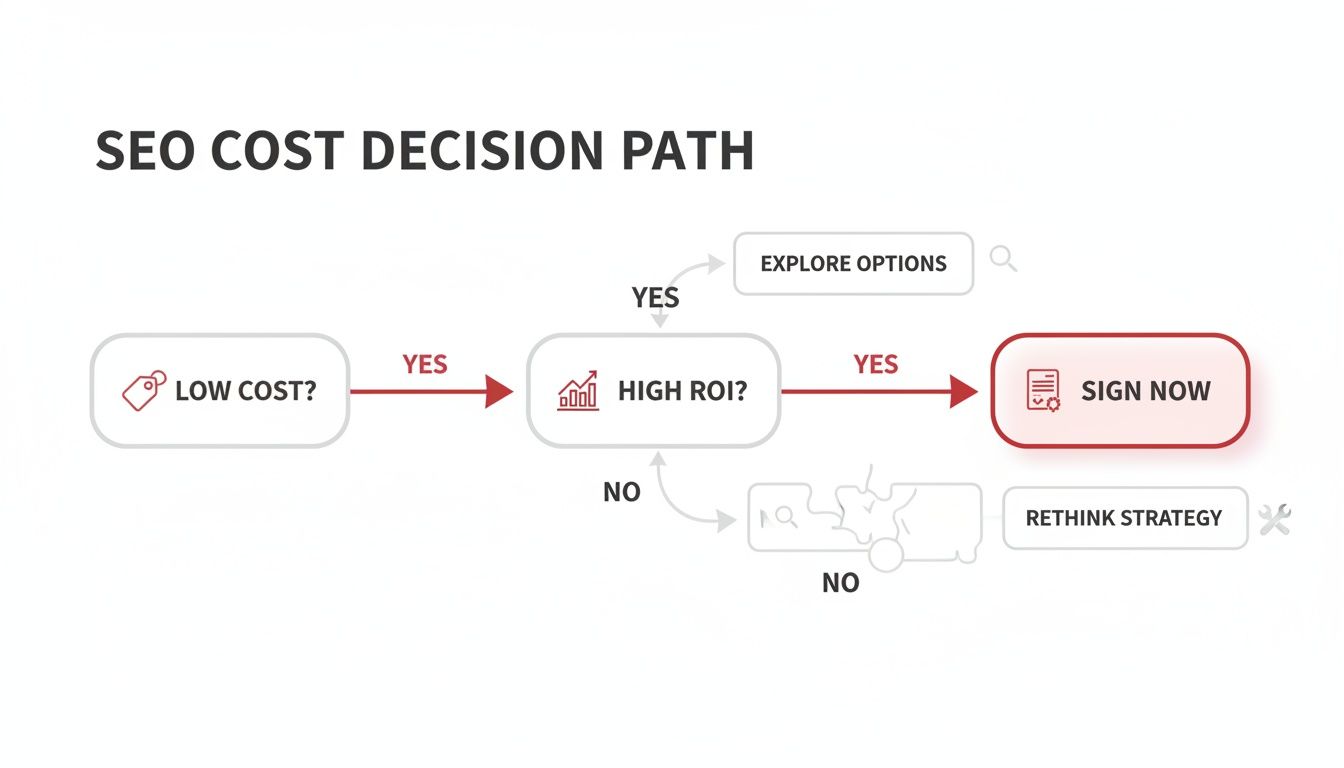
This simple flowchart can help you think through the relationship between what you pay and the value you should expect to get.

Flowchart illustrating an SEO cost decision path, evaluating low cost, high ROI, and strategy.

As the chart shows, a low price is only a good deal if it leads to a high return on investment. That is the real goal of any marketing.

Getting the Commercials and Commitment Straight

Finally, you need to be absolutely clear on the terms of the deal. Getting this wrong can lead to major headaches down the track.

Get straight to the point:

  • "What are your contract terms and notice periods?" Some agencies will try to lock you into a 12-month contract from day one. A more flexible arrangement, like a 30-day notice period after an initial few months, shows they are confident they can keep delivering value.

  • "Who will I be dealing with? Will I have a dedicated contact?" You need to know you can pick up the phone and talk to someone who actually knows your business. Having a dedicated account manager is a great sign that they prioritise clear communication.

Here is a quick checklist you can use when you are talking to potential agencies. It covers the key questions to ask and the warning signs to look out for.

Agency Vetting Checklist Questions and Red Flags

Use these questions to interview potential SEO agencies and watch out for the corresponding red flags.

Question to Ask What a Good Answer Includes Potential Red Flag to Note
"Can you show me results for other tradies?" Specific case studies, examples of improved rankings for local keywords, and measurable increases in leads or phone calls. Vague answers, no relevant examples, or showing results from completely different industries.
"What will the first 90 days look like?" A clear, structured plan involving an audit, keyword research, on-page fixes, and setting up tracking. "We'll start building links straight away" or a lack of a clear, foundational process.
"How do you measure success and what's in your reports?" A focus on business goals like phone calls, quote requests, and website enquiries. They should offer a clear sample report. Focusing only on vanity metrics like "traffic" or "impressions." Reports that are confusing or full of technical jargon.
"What are your contract terms?" Flexibility. An initial commitment period (e.g., 3-6 months) followed by a monthly rolling contract or short notice period. Being pushed into a long-term (12+ month) contract from the very beginning.
"Do you guarantee #1 rankings on Google?" A firm "No." They should explain that nobody can guarantee rankings and focus on their process for achieving growth. Any agency that promises or "guarantees" a #1 ranking. This is a classic sign of an untrustworthy provider.

Having these questions ready gives you the confidence to lead the conversation and make a smart decision. The right agency will welcome this level of detail and provide calm, clear, and honest answers. They will make you feel reassured, not pressured.

Red Flags and Common SEO Cowboys to Avoid

Choosing the wrong SEO provider can set you back a lot more than just the money you have paid them. A dodgy operator can actively damage your online reputation, making it much harder to get leads down the track. This part of the guide is all about spotting the warning signs early, so you can steer clear of the cowboys and find a genuine partner.

We are not trying to scare you off. The goal here is to arm you with the knowledge to sniff out a bad deal from a mile away. It is about protecting your business and making sure your hard-earned cash goes towards real, long-term growth.

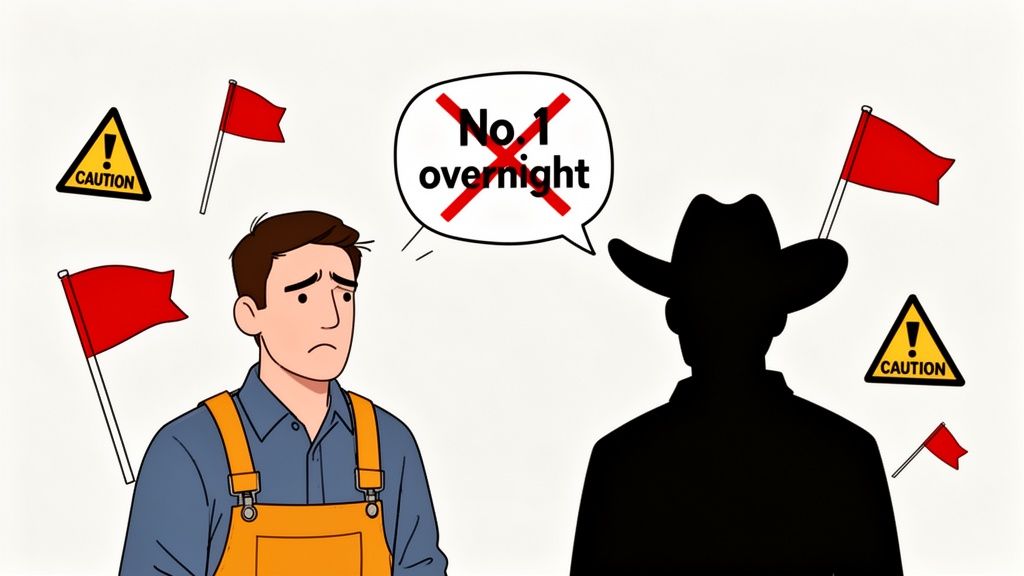
A distressed man faces a cowboy silhouette, surrounded by caution signs and red flags, rejecting 'No. 1 overnight' claim.

The "Guaranteed Number One" Promise

This is the oldest trick in the book and the biggest red flag you will ever see. If an agency promises or "guarantees" you the number one spot on Google, run for the hills. Seriously, end the conversation right there. No one can guarantee rankings because nobody controls Google’s algorithm.

A legitimate New Zealand SEO agency knows that rankings are earned through consistent, quality work, not by flicking some magic switch. They will talk about their process, their strategy, and their focus on steady improvement—not impossible promises. Think about it: if they could truly guarantee the top spot, they would be charging a fortune and would not need to be cold-calling you in the first place.

High-Pressure Sales Tactics

You know that feeling when a salesperson is pushing you for a quick decision? They might offer a "special one-time discount" if you sign up today or create a false sense of urgency. This is a massive warning sign.

A reliable SEO partner is looking for a long-term relationship, not a quick sale. They should give you the time and space to review their proposal, ask questions, and feel completely comfortable with your decision.

A professional agency acts as a calm, reassuring advisor. Their confidence comes from their process and results, not from pressuring you into a contract you are not ready for.

Secret Strategies and a Lack of Transparency

If you ask an agency what they will be doing for you each month and they become evasive, be very cautious. Vague answers like "we use proprietary techniques" or "it's too technical to explain" are often a cover for doing very little—or worse, for using risky tactics that could get your site penalised by Google.

A trustworthy partner will be happy to walk you through their strategy in plain English. They should be able to clearly explain:

  • On-page SEO: How they will improve your website’s content and structure to better match what your customers are searching for.
  • Off-page SEO: Their approach to building your site's authority, such as getting you listed in quality local directories.
  • Technical SEO: The work they do behind the scenes to make sure your site is fast, secure, and easy for Google to understand.

They should be an open book. After all, it is your business and your money on the line.

An Obsession with Link Building Above All Else

Links pointing to your website are important, but they are just one piece of a much larger puzzle. Some low-quality providers focus almost entirely on building hundreds or even thousands of cheap, spammy links from irrelevant websites.

This is a dangerous game. Google is incredibly good at spotting these unnatural link schemes, and they can lead to a severe penalty that makes your website completely disappear from search results. A penalty like that can take months, or even years, to recover from. A quality agency will talk about earning links naturally through great content, local citations, and building genuine relationships online. Their approach is all about quality, not just sheer quantity.

Steering clear of these red flags is the first step toward finding a New Zealand SEO agency that will become a valuable asset to your business. The right partner will be transparent, realistic, and focused on delivering real-world results that help you win more work.
Ready to talk to an agency that ticks all the right boxes? Reach out to us for a straightforward chat about how we can help your trade business grow.

So, What’s Your Next Move to Get More Work Online?

You now have a solid idea of what separates genuine SEO experts from the pretenders. Picking the right one is a big deal for your business, and it is all about having a clear, methodical plan. This is not about taking a punt; it is about making a smart investment in your business's future.

The road to a choc-a-bloc work calendar starts with taking deliberate steps. It begins with knowing your own goals, checking out potential agencies with a sharp eye, and asking all those tough, specific questions we have covered. From there, it is about choosing a team you can actually trust—a partner who speaks your language and understands that your bottom line is more calls and quote requests.

Your Game Plan from Here

Let’s pull all this together into a simple game plan. This is not rocket science; it is just a checklist to take you from where you are now to making a call you feel good about.

  • Nail Down Your Goals: Before you even think about picking up the phone, get crystal clear on what you actually need. Is it more emergency call-out jobs? Are you trying to line up more big-ticket renovations? Knowing exactly what a "win" looks like helps you and any potential partner focus on what really matters.

  • Do Your Homework: Create a shortlist of a few agencies that look like they specialise in working with tradies. Dive into their websites, read their case studies, and see if they talk your language. Do they sound like they understand the day-to-day grind of your job?

  • Run the Interview: Use the questions we went over earlier as your script. A good agency will be happy to answer your detailed questions and will give you calm, straight answers. Do not forget, you are the one in the driver's seat here.

Making the Final Call

After you have chatted with a few different outfits, the right choice should feel pretty obvious. The best agency will leave you feeling confident and reassured, not confused or backed into a corner. They will have shown they genuinely understand your trade and laid out a logical, transparent plan to get you results.

Choosing an SEO partner is a massive act of trust. You are handing over your online reputation and your marketing budget. Go with the team that earns that trust through straight-up honesty, real expertise, and clear communication.

At the end of the day, the whole point of marketing is to free you up to do what you do best. A solid New Zealand SEO agency works away in the background, consistently lining up new jobs so you can stay on the tools, manage your team, and deliver top-notch work for your customers.

For a bigger picture of what a full digital strategy involves, you might find our guide on New Zealand online marketing useful—it goes well beyond just SEO.

The path to a more predictable stream of work is right there for the taking. It all starts with making an informed decision to team up with an expert who can handle the online world for you, making sure that when a local customer needs a tradie, you’re the first name they see.


Taking that first step is always the hardest. At Trades Online, we make it simple. We offer a no-obligation, straight-up chat to see if we are a good fit for your business. Let's talk about your goals and show you exactly how we can get you in front of the customers who are searching for you right now. Get in touch with us today.

Categories
Uncategorized

Web Design Price: Your NZ Guide to Budgeting a Site That Wins Jobs

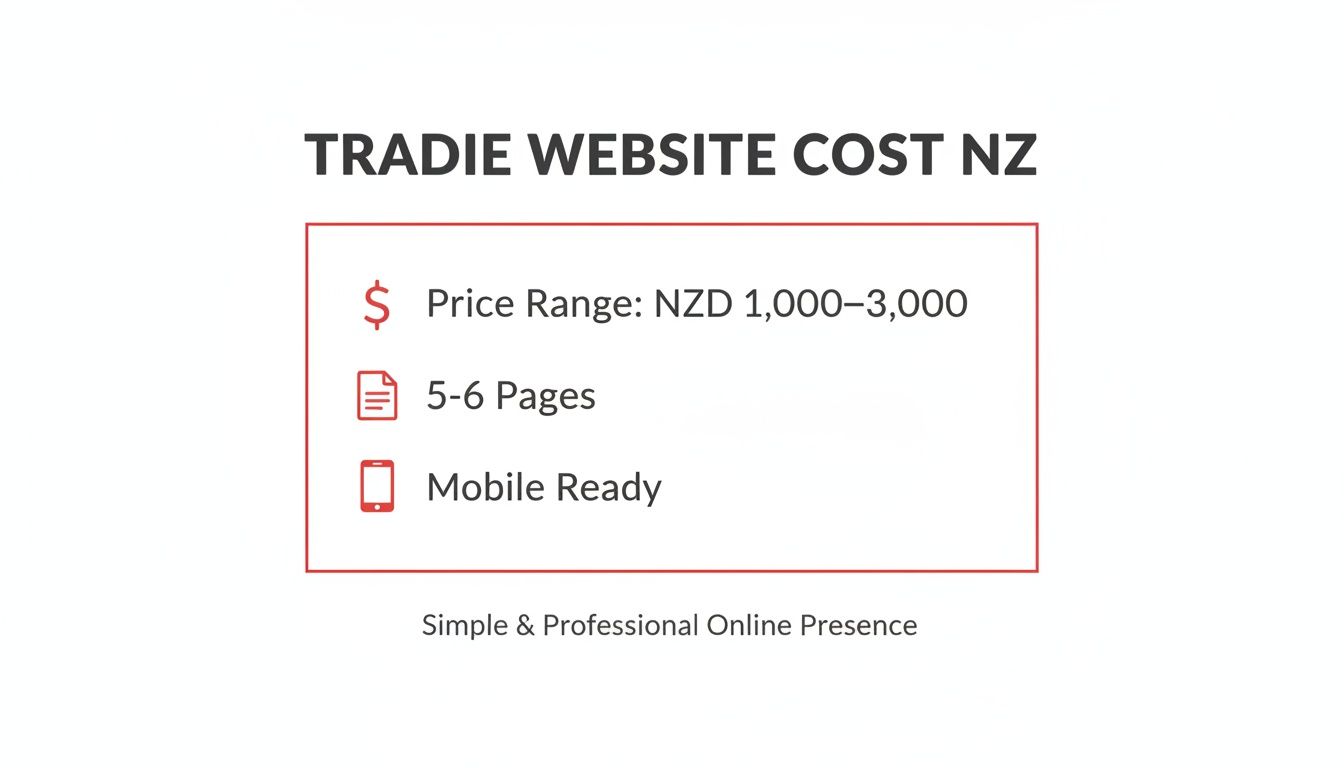
Let's get straight to it. For a professional website that actually gets the phone ringing, a New Zealand tradie should expect to invest somewhere between NZD $1,000 and $3,000. This isn't just for a pretty online brochure; it's for a solid, lead-generating tool built to attract local customers and showcase your quality work. We understand that figuring out costs can be a hassle, so our goal is to make this process as clear and straightforward as possible for you.

Breaking Down Web Design Prices for Kiwi Tradies

Trying to figure out website costs can feel like you're getting quotes for a job with no plans. You'll see prices all over the map, from a few hundred dollars on a DIY platform to eye-watering five-figure sums from big agencies. It’s tough to know what’s a fair price and what’s overkill for what you actually need.

The reality is, as a tradie, you don't require a massively complex site with all the bells and whistles. What you need is a hardworking, reliable online tool that makes it easy for potential customers to request a quote or pick up the phone. We specialise in creating exactly that—effective websites designed with the specific needs of New Zealand tradesmen in mind.

Think of your website as your digital storefront, your portfolio, and your best salesperson, all working for you 24/7. Its main job is to build trust before you've even had a conversation with a potential client. A clean, easy-to-navigate site instantly tells people you’re a professional who cares about quality. It’s a smart investment that should pay for itself over and over again by landing you more work.

What Should You Expect for Your Money?

For most Kiwi builders, plumbers, electricians, and other tradies, a strong, straightforward website is the perfect place to start. It gives you everything you need to look credible online without getting bogged down in features you'll never use. Our experience shows that focusing on the fundamentals delivers the best results.

A good quality tradie website should always include:

  • A clean, professional design that reflects your business, not a generic template.
  • Clear descriptions of your services so people know exactly how you can help them.
  • A gallery or project page to show off photos of your best work—proof is in the pudding, after all.
  • An impossible-to-miss contact page with a simple form and your phone number readily available.
  • Mobile-first design, because most of your customers will find you on their phone while on the go.

This infographic sums up what a typical starter package for a New Zealand tradie looks like.

Infographic showing tradie website costs in NZ, including price range, 5-6 pages, and mobile readiness.

This price range gets you a robust, professional site with just the right number of pages to properly explain your services, display your work, and build that crucial trust with visitors.

Typical Website Packages for New Zealand Tradies

To make it even clearer, here’s a quick comparison of the common website packages you'll come across. This should help you figure out where your business fits and what you can expect for your investment.

Package Type Best For Typical Price Range (NZD) Key Features
Starter Tradie Site Sole traders or small teams just getting started online. $1,000 – $3,000 5-6 pages (Home, About, Services, Gallery, Contact), mobile-responsive, basic on-page SEO, contact form.
Business Growth Site Established businesses looking to generate more leads and stand out. $3,000 – $6,000 Everything in Starter, plus more service pages, a blog, advanced SEO, testimonials section, basic analytics setup.
Custom Pro Site Larger companies or those needing specific features like online booking or quoting tools. $6,000+ Fully custom design, e-commerce or booking integration, advanced functionality, in-depth SEO strategy, content creation.

This table shows that the $1,000 – $3,000 sweet spot is perfect for most trades. It covers the essentials needed to compete online in New Zealand without a massive upfront cost. You can learn more about how these web design fees are structured to understand what goes into the pricing.

Our goal is always to provide you with a website that starts paying its own way as quickly as possible. You can always add more features and expand it down the track as your business grows.

So, What Actually Determines Your Website's Price Tag?

Ever wonder why one quote for a website comes in at $2,000 and another lands at $10,000? It’s not just a random number. The final cost of a website is a lot like quoting a building job—it all boils down to the scope, the materials, and the level of finish you’re after.

Think of it this way: a simple, single-car garage is a straightforward build with a pretty predictable cost. But a custom-designed, multi-level home with an architect's plan, high-end fittings, and complex structural work? Well, that's a whole different story, and the price will reflect that. It’s the exact same principle in web design.

A basic website gets the job done, just like that garage. But the moment you start adding more pages, custom features, or slick design work, the time, skill, and complexity shoot up, and so does the price.

The Blueprint: Number of Pages

The most obvious factor that affects your website's price is the number of pages. It’s quite simple, really. Each page needs to be planned out, designed, have content written for it, and then be built.

For most tradies, a five-page site is a brilliant starting point—think Home, About, Services, Gallery, and Contact. But sometimes, you need more room to move.

You might want separate pages for each of your key services, like "New Home Builds," "Kitchen Renovations," and "Decking & Fencing." More pages mean more work for the designer and content writer, which naturally bumps up the cost.

Custom Design vs. Off-the-Shelf Template

This is another massive fork in the road when it comes to cost. A website built from a pre-made template is like picking a standard plan for a new build. It's faster and more affordable because the fundamental structure is already locked in. The designer just drops in your branding, colours, and content.

A fully custom design, on the other hand, is like hiring an architect to draw up unique blueprints just for you. Every single element, from the layout of your project gallery to how your contact form works, is designed from the ground up to meet your specific goals. This approach takes a lot more time and a deeper dive into user experience and interface design, making it a bigger investment.

A custom-built website isn't just about looking different; it's about functioning in a way that is perfectly aligned with how your specific customers think and act, which can lead to more quote requests and phone calls.

Special Features and Functionality

Right, beyond the standard pages, any special features you add will tack more onto the final price. These are the "bells and whistles" that can make your site work harder for you, but they all require extra development time.

Common extras for a tradie’s website include:

  • Advanced Photo Galleries: Need galleries with filters so clients can sort projects by type (e.g., "Bathrooms," "Kitchens," "Extensions")? That takes more work than a simple grid of photos.
  • Online Booking Systems: Want to let clients book a consultation or a service call directly through your site? Integrating a calendar system is a complex feature that adds real value, but also real cost.
  • Custom Quote Forms: A basic contact form is standard. But a detailed form that asks specific questions to help you pre-qualify a job—like dimensions, material choices, or photo uploads—needs custom development.
  • E-commerce Functionality: If you plan to sell products directly, like parts or branded gear, setting up a secure online shop is a significant addition to the project.

Each of these features adds another layer of complexity to the build. Knowing which ones you actually need will help you get a site that delivers results without blowing the budget. For a deeper look at what goes into the overall expense, this complete guide to website cost for small businesses is a great resource.

Choosing Between a Starter or Custom Website

Deciding between a starter package and a fully custom website is one of the first big calls you'll have to make. Think of it like choosing between a top-quality pre-built cabin and an architect-designed home. Both give you a solid roof over your head, but they're built for very different needs, budgets, and long-term plans.

To nail this choice for your trade business, you need to get your head around what each option actually delivers. There’s no single “best” answer here—it all comes down to where your business is at today and where you want it to be tomorrow.

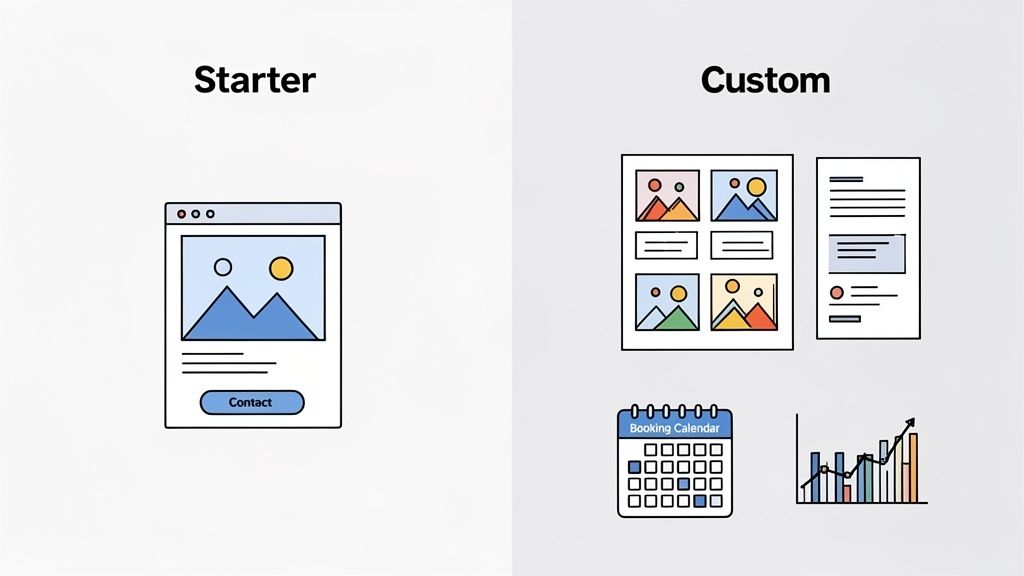
An illustration comparing a basic starter web design layout to a custom web design with advanced features like calendars and graphs.

The Power of a Starter Website

A starter website, often called a "brochure" site, is a brilliant, cost-effective way to get your business online quickly and professionally. It’s the perfect tool for sole traders or smaller teams who need a solid online presence to look credible and get found by local customers. Simple as that.

It's your digital business card and work portfolio, rolled into one. It’s designed to do a few jobs, and do them extremely well:

  • Establish Professionalism: It shows potential clients you’re a serious, legitimate operation.
  • Showcase Your Work: A clean, simple gallery proves your skills and the quality of your workmanship.
  • Make Contact Easy: It gives customers a dead-simple way to get in touch for a quote.

A starter site usually takes a proven, high-performing layout and personalises it with your branding, photos, and services. Because the heavy lifting on the structure is already done, the build process is much faster. That efficiency translates directly to a lower web design price for you. It’s all about getting the fundamentals right without overcomplicating things.

When to Level Up to a Custom Website

As your business grows, your website needs to grow with it. A custom-built website is engineered to support that growth, acting as a powerful lead-generation machine, not just an online brochure. This is the right move for established tradies looking to scale up, own their local market, and put their website to work.

A custom site is built from the ground up, tailored specifically to your business goals and your ideal customer. It goes way beyond the basics to include features that actively turn visitors into paying clients. You can see how we apply this specialised approach for websites for builders to understand how a bespoke solution makes all the difference.

A custom website isn't just about a unique look. It's about building a strategic tool that streamlines your sales process, from attracting the right kind of client to making it easier for them to request a high-value job.

This strategic approach means bringing in more advanced features. For New Zealand tradies looking to scale, a 5-page custom website with advanced layouts—think integrated review showcases, detailed project galleries, and smart lead-capture forms—typically ranges from NZD 2,999 to 6,000 + GST. This is the sweet spot for builders and electricians who are hungry for qualified leads. That price reflects the detailed, strategic work needed to create a site that doesn’t just look good, but actively brings in business.

So, how do you decide? If you're starting out and just need to get online professionally without breaking the bank, a starter site is your best bet. If you're established, ready to invest in serious growth, and need your website to be a core part of your lead generation strategy, it's time to talk about a custom build.

What About Ongoing Website Costs After Launch?

Getting your new website live is a massive step, but it's not quite the finish line. A website isn't a 'set and forget' tool. Think of it like your work ute – you don't just buy it and drive it forever. It needs a regular WOF, oil changes, and new tyres to stay safe and reliable on the road. Your website is exactly the same; it needs a bit of ongoing attention to keep it running smoothly and bringing in new jobs.

Knowing about these running costs from the get-go means no nasty surprises later on. It helps you budget properly and treat your website for what it is: a crucial, long-term business asset, not just a one-off purchase. A small, planned investment in upkeep is always a better bet than getting lumped with a huge, unexpected bill to fix a site that’s been hacked or has simply stopped working.

The good news is these costs are predictable and totally manageable. They're what keep your online shopfront secure, fast, and easy for potential customers to find when they're searching for a tradie in your area.

The Core Running Costs for Your Website

Once your site is up and running, a few essential services keep it online, secure, and accessible. These aren't optional extras; they're the non-negotiables for any professional website.

Here’s a simple breakdown of what these ongoing costs cover:

  • Domain Name Renewal: This is the small annual fee to keep your website address (like yourbusiness.co.nz). If you forget to renew it, you lose it, and another business could snap it up.
  • Website Hosting: Think of hosting as the rent you pay for your website's space on the internet. It's the physical server where all your site's files, images, and content live, so people can actually visit it.
  • Security and Software Updates: The software that runs your website (like WordPress and its plugins) is constantly being updated to close security gaps and improve how it works. Not keeping these up-to-date is like leaving the workshop door unlocked overnight – it’s an open invitation for hackers.

These three things are the bare minimum for a professional online presence that customers will trust.

Budgeting for Your Website's Long-Term Health

So, what should a Kiwi tradie expect to set aside for these running costs? While the numbers can vary, it’s vital to have a clear idea so you can plan ahead. A bit of forward-thinking here ensures your website continues to be a lead-generating machine for your business.

Your website is your hardest-working employee. It’s on the job 24/7, pulling in leads while you sleep. And just like any top-performing team member, it needs a modest, regular investment to keep it in peak condition.

For most trade businesses in New Zealand, ongoing website expenses typically land somewhere between NZD $1,300 and $4,500 per year after the initial build. This is a critical part of your budget that keeps the customer enquiries flowing. These costs usually break down into domain registration ($30–$50/year), hosting ($300–$600), security and maintenance ($600–$2,400), and software/plugin licenses ($100–$500).

To make life easier, our monthly care plans bundle all of these essentials into one predictable fee, so you never get hit with a surprise bill. You can dig a bit deeper into typical costs in this helpful New Zealand price guide.

Why a Website Care Plan Makes Sense

Instead of trying to juggle separate bills for your domain, hosting, security scans, and software updates, a monthly care plan rolls everything into one simple payment. It’s the easiest and most reliable way to look after your website's health, especially if you're not a tech expert.

A good care plan, like the ones we offer, takes all the technical headaches off your plate. We handle the security monitoring, run the software updates, and make sure your site is backed up regularly, just in case something goes wrong. This proactive approach means we often spot and fix small glitches before they turn into big, expensive problems. It gives you complete peace of mind, knowing your investment is protected and working hard for you.

And if you're already investing in bringing traffic to your site, you might find our guide on what to expect from Google Ads in Auckland useful too.

How a Great Website Pays for Itself

It’s easy to get a quote for a new website and just see the number at the bottom as a cost. But that’s looking at it all wrong. A great website isn't an expense; it's a strategic investment and a true profit engine for your business.

Think of it like your hardest-working employee. It’s on the job 24/7, never calls in sick, and is always ready to show potential customers exactly why you’re the right tradie for them. Its whole purpose is to turn casual online visitors into genuine enquiries, keeping your job pipeline full.

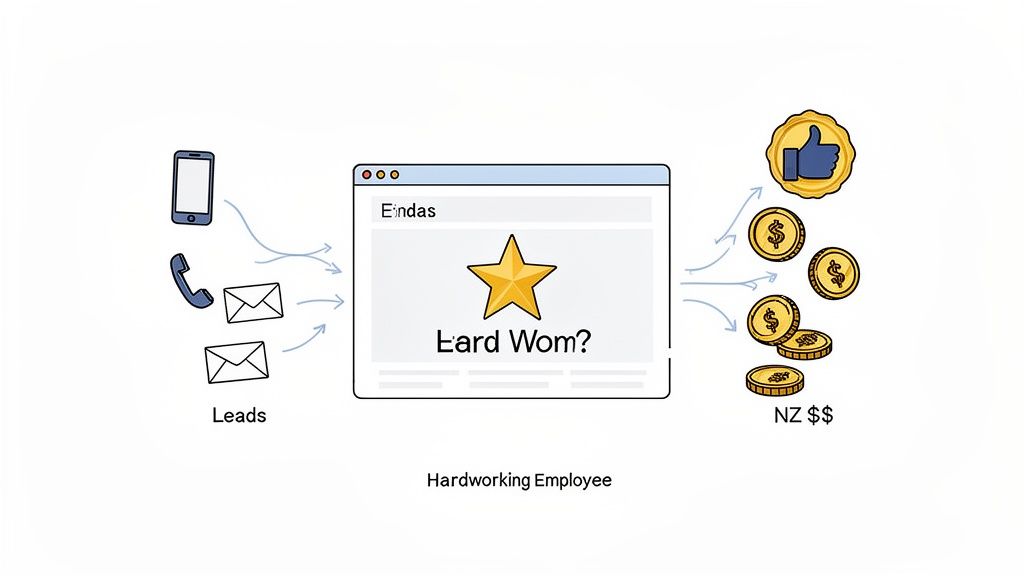
Diagram illustrates business leads from phone and email converting into employee rewards and New Zealand dollars.

Building Trust Before the First Handshake

When a homeowner in your area needs a builder, plumber, or sparky, the first thing they’ll do is jump online. A professional, easy-to-navigate website instantly builds a foundation of trust and credibility. It signals you're a serious, established business that cares about quality, right from that first click.

This isn’t just about looking sharp; it's about making potential customers feel confident enough to actually pick up the phone. A site that looks dated, is a nightmare to use on a mobile, or has broken links can make people second-guess the quality of your workmanship. A clean, modern site does the exact opposite—it reassures them they're dealing with a pro.

From Website Visitor to Qualified Enquiry

A great website does more than just sit there looking good. It actively works to convert visitors into solid leads by giving people exactly what they need to make a decision.

Showcasing your past jobs and happy customers is one of the most powerful ways to do this. Think about including these crucial elements:

  • A Detailed Project Gallery: High-quality photos of your finished work are undeniable proof of your skills. It lets potential clients see the standard you hold yourself to.
  • Genuine Customer Testimonials: Positive reviews from past clients are gold. When someone reads about another happy customer’s experience, it builds a massive amount of trust.
  • Clear Calls-to-Action: Your website should make it incredibly easy for someone to get in touch. Prominent phone numbers and simple contact forms remove any hassle, turning their interest into action.

These features guide visitors through a natural process. They build confidence at each step until ringing you for a quote feels like the obvious next move.

Calculating Your Return on Investment

Let’s break down the return on investment (ROI) in real-world terms. It's simpler than you might think. The initial web design price might feel like a big number, but you might only need to land one decent job to cover the entire cost.

Imagine your new website costs $3,000. If you land a single small bathroom reno or a week-long building project directly from that site, it has already paid for itself. Every single lead that comes through after that is pure profit.

And don't forget the lifetime value of a new customer. That one job could easily lead to more work with the same client down the track, or referrals to their friends and neighbours. When you look at it that way, a professional website isn't an expense at all—it’s one of the smartest, most profitable investments you can make for your trade business. It’s a tool built to bring you work for years to come.

Alright, you've got the lay of the land now. You know what goes into building a website that actually pulls its weight for a trade business, from a simple starter site to a full-on custom job. That knowledge is power—it means you're ready to make a smart call, not just a blind guess.

The next step? Getting a real plan, with real numbers, for your specific business.

Think about it. If your website is old, clunky, or just plain non-existent, you're likely leaving money on the table. Right now, Kiwis in your area are searching online for exactly what you do. If they can't find you, they'll find the next person on the list. That's a leaky bucket we can fix.

Let's Map Out Your Online Game Plan

We build websites for Kiwi tradies. It’s what we do. We know you need something that looks sharp, works flawlessly, and most importantly, gets your phone ringing with new jobs. Our whole process is designed to be dead simple for you, so you can focus on your work while we handle the techy stuff.

Let's figure out what you actually need to start winning more work online. We can match the right features and the best approach to your budget and your goals.

A professional website is one of the best investments you'll ever make. It's your 24/7 salesperson, building trust and bringing in leads while you're on the tools or even fast asleep.

Why not book a free, no-pressure chat with us? We'll take a look at where you're at and give you a straight-up, detailed quote to get you sorted online. No hard sell, just honest advice aimed at getting you more business.

Ready to turn your website into a lead-generating machine?

[Book Your Free, No-Obligation Website Strategy Session Today]

Got Questions About Web Design Prices?

Fair enough. Here are the most common questions we get from Kiwi tradies about website costs. We've laid out some straight-up answers to help you make a smart decision for your business.

Why Can't I Just Use a Cheap DIY Website Builder?

Look, those DIY builders seem like a great deal on the surface, but they often end up costing you more in the long run. Not in dollars, necessarily, but in lost jobs and missed opportunities. While you might save a few bucks upfront, those template sites rarely look professional enough to build real trust with potential customers.

Your time is your money. It's much better spent on the tools than wrestling with a drag-and-drop editor trying to become a part-time web designer. A professionally built site is set up from day one to actually bring in leads, work flawlessly on a phone, and get found on Google.

Think of it this way: you wouldn't tell a homeowner to have a crack at their own wiring. The same logic applies to your single most important marketing tool.

A professional website isn't just a pretty online brochure. It’s a tool built specifically to turn a curious visitor into a solid quote request—something a generic DIY template just can't do.

How Long Does It Take to Build a Website?

Good question. The honest answer is, it depends on how complex the site is. For a solid starter website for a tradie, you’re typically looking at about four to six weeks from our first chat to launch day. This gives us enough breathing room to properly plan, design, write the content, and build a site that just works.

If you're after something more custom with a few extra bells and whistles, it might take a bit longer. One thing that really helps speed things up is having your photos and service info ready to go. We'll keep you in the loop every step of the way, so you'll always know where things are at.

What Do I Need to Provide to Get Started?

Not as much as you might think. The main thing we need is a clear idea of what you want this website to do for your business—is it more leads? A place to show off your work? We'll help you figure that out.

To help us build a site that really shows off your skills, it's great if you can pull together:

  • Your Logo: If you've got one, great. If not, no worries, we can help with that too.
  • Photos of Your Work: Good, clear photos of your best projects are gold. They do the selling for you.
  • Details About Your Services: Just a basic list of what you do is a perfect starting point.

Don't stress if you don't have professional photos or perfectly worded text. Our job is to take what you've got and shape it into a polished, professional website that gets you more work.

Will My Website Work on Mobile Phones?

Absolutely. In this day and age, it's not even an option—it's essential. Most of your potential customers are going to find you on their smartphone, probably while they’re out and about. If your site is a clunky mess on mobile, they'll just hit the back button and call your competitor.

Every single website we build is created using a mobile-first approach. This means we design it to look amazing and work perfectly on a small screen first, and then we make sure it looks great on a desktop. This guarantees a smooth experience for everyone, which ultimately means more enquiries and more jobs in your calendar.


Ready to get a clear, no-nonsense quote for a website that will work as hard as you do? The team at Trades Online is here to help. We build straightforward, high-performing websites for Kiwi tradies that are designed to bring in more work.

Get Your Free Website Audit and Quote Today

Categories
Uncategorized

A Kiwi Tradie’s Guide to Choosing a Social Media Agency in New Zealand

So, what exactly is a social media agency in New Zealand? Put simply, it’s a team of experienced professionals who help trade businesses like yours find new customers online. They manage your business presence on platforms such as Facebook and Instagram, making sure you look professional and get seen by local homeowners who need your services. For a Kiwi tradie, this means having experts showcase your quality work and build trust in your community, which turns online interest into genuine job enquiries. It is a reliable way to grow your business without taking you off the tools.

Why Bother With Social Media? A Straight-Up Guide for Kiwi Tradies

A cartoon tradesperson holds a smartphone with social media apps, advertising building services in New Zealand, open 24/7.

We understand that you're flat out on the tools, not scrolling through social media feeds. The idea of paying someone to run a Facebook page might seem like an unnecessary expense. However, the way customers find and choose a builder, plumber, or electrician has changed significantly. Today, your next big job is less likely to come from the local paper and more likely from someone who saw your impressive work on their phone while relaxing at home. A professional social media presence is no longer just a 'nice-to-have'; it's your digital showroom, open 24/7 and working for you even when you're on site.

Reaching Customers Where They Already Are

Your potential clients are online every single day, a fact supported by solid data. Here in New Zealand, there are 4.24 million active social media users, which is a staggering 80.6% of the population. For a trade business, this represents a massive pool of potential customers ready to be engaged. A well-run social media campaign can effectively turn those casual scrollers into genuine quote requests, connecting you with homeowners in your service area. This isn’t about chasing likes; it's about establishing visibility and trust in your local community, whether you're based in Auckland, Christchurch, or Invercargill. You can get a better sense of the big picture by reviewing the latest details about local social media stats.

Think of it this way: a professionally managed social media page is like a constant, reliable referral. It showcases your best work, shares rave reviews from happy customers, and answers common questions before anyone even picks up the phone.

Build Trust Before You Even Meet

A solid online presence builds instant confidence. When a homeowner can easily find clear photos of your past projects, read testimonials from other locals, and see that you are an active, professional business, they are far more likely to trust you with their job. This provides a simple way to stand out from the competition and prove your reliability from the very first interaction. To get ahead in today's market, Kiwi tradies need to embrace proven digital marketing tips for small businesses, and an experienced agency can put these strategies into practice for you. A specialist partner understands how to combine great photos and videos with the right words to bring in real-world jobs, not just online noise.

Ready to see how a no-nonsense social media plan can bring in more work? Get in touch for a chat about your business—we offer a calm, professional service with no pressure.

What a Good Social Media Agency Actually Does

You might hear ‘social media management’ and think it’s just about posting a few photos online now and then. For a Kiwi trade business, however, what a professional agency actually does is far more strategic. Think of it as a complete system designed to find you more work, allowing you to stay focused on the tools where you belong. The process begins with a solid plan. A good agency doesn't just post on a whim; first, they take the time to understand your business inside and out. They learn about your ideal customers, what makes your service different, and the specific areas you service. From there, they build a clear strategy to reach homeowners who are actively looking for a reliable builder, electrician, or plumber right in your local area.

More Than Just Snapping a Few Pics

Once the game plan is sorted, the focus shifts to creating content that effectively shows off your skills and builds trust. This involves more than just a quick photo on your phone.

Here’s what’s involved:

  • Professional Content: They create posts using high-quality photos and videos of your finished jobs, making the quality of your workmanship shine.
  • Engaging Captions: They write clear, simple text that tells the story behind the job, connecting with potential customers on a human level.
  • Consistent Scheduling: They post regularly so your business always looks active, dependable, and ready to take on new projects.

This consistency is crucial. It shows potential customers that you are a serious, professional organisation they can count on.

The Nuts and Bolts of Finding You Customers

Beyond creating great content, a skilled agency gets into the detailed work that turns online views into actual phone calls. This is where you see the real value in their service. They run targeted ad campaigns on platforms like Facebook and Instagram, putting your services directly in front of people in your town who need them. This ensures your ad budget is spent smartly, reaching potential clients who are genuinely in the market for your trade, rather than being wasted on a massive, uninterested audience. The goal is always to drive real leads, not just to accumulate 'likes' and followers that don’t pay the bills.

A top-notch agency will always be able to show you the money. Understanding how to actually prove ROI on social media is a game-changer, and a good partner will give you simple reports showing exactly how their work is bringing in more business.

At the end of the day, a good agency takes all this digital marketing hassle off your plate. They handle the strategy, create the posts, run the ads, and track the results. This frees you up to do what you do best—delivering top-quality work for your clients.

If you’re ready to have a professional team look after your online presence and bring in a steady stream of local work, let’s have a chat. We can show you exactly how we get it done for tradies all over New Zealand.

What You're Actually Paying For: The Services That Get You Work

When you bring a social media agency on board, you’re not just paying someone to post a few updates online. You are investing in a proven system designed to bring you more quotes and more jobs. For tradies, it is crucial to know which services actually make the phone ring and which are just unnecessary extras. A good agency will not try to confuse you with technical jargon. Instead, they will offer a straightforward package that covers the essentials: creating content that shows you're a professional, managing your online reputation, running ads that reach local homeowners, and reporting back in plain English.

This diagram gives you a bird's-eye view of how a results-focused agency typically works.

Flowchart showing agency services: strategy, content creation, and advertising steps with relevant icons.

As you can see, the process starts with a solid plan, followed by the creation of great content, and then making sure the right people see it through smart advertising.

Content That Shows Off Your Workmanship

This is the foundation of your social media presence. For a tradie, your feed is your portfolio—it’s where potential customers decide if you are the right person for the job. A good agency understands this and focuses on content that communicates quality and reliability.

What does that look like in practice?

  • Project Showcases: Crisp before-and-after photos and short, snappy videos of your best work. This is the ultimate proof that you deliver excellent results.
  • Client Testimonials: Taking a happy customer’s feedback and turning it into a professional-looking graphic. It’s a powerful way to build trust before you've even spoken to a new client.
  • Behind-the-Scenes Shots: Photos of you and your team on the job. This puts a human face to the business and makes you seem much more approachable.

The whole point is to build a gallery of your work that speaks directly to Kiwis in your service area. We break down more of our content strategies in our guide to social media marketing in Auckland.

Essential Social Media Services for NZ Tradies

When you're vetting an agency, it's helpful to know what's a non-negotiable and what's a nice-to-have. This table breaks down the core services you should expect.

Service What It Means for Your Business Why It's a Must-Have
Strategy & Planning A clear roadmap outlining goals, target audience, and content themes. Without a plan, you are simply posting randomly and hoping for the best.
Content Creation High-quality photos, videos, and graphics of your work. This is your digital portfolio. It’s what convinces customers to call you.
Paid Advertising Targeted ads on platforms like Facebook and Instagram to reach local homeowners. Ensures your great work is seen by people who actually need your services.
Community Management Replying to comments and messages quickly and professionally. Shows you’re responsive and reliable, building trust from the first interaction.
Reporting & Analytics Simple, clear reports showing leads, website clicks, and calls generated. Proves your investment is working and tells you what’s getting results.
Profile Optimisation Making sure your business info, contact details, and branding are consistent. Makes it incredibly simple for potential customers to find and contact you.

While extras like influencer marketing or advanced video production can be beneficial down the track, the services in this table are the engine room of a successful social media presence for any trade business.

Targeted Ads and Clear Reporting

Having great content is one thing, but you need the right people to see it. That's where paid advertising comes in. With New Zealand's social media ad spend projected to hit US$459.46 million in 2025, it's a powerful tool that your competitors are almost certainly using.

For a trade business, a well-managed Facebook ad campaign can drive 30-60 website clicks per post, turning into real quote requests. Instagram is brilliant for visual trades like painters or landscapers, while LinkedIn is fantastic for connecting with other businesses in the construction sector. You can dig into the numbers yourself with the latest ad spend projections on Statista.com.

A reliable agency won't hide behind confusing graphs and spreadsheets. They will provide simple, clear reports that show you exactly how many enquiries, website visits, or phone calls their work generated. This accountability is non-negotiable—it's how you know your investment is actually paying off.

Finally, never underestimate community management. This is simply the professional term for replying to comments and messages. When an agency handles this for you, they ensure every potential customer receives a prompt, professional response. It shows you’re on the ball and builds confidence long before you even price the job. It’s these core services, all working together, that turn your social media from a simple online noticeboard into a genuine lead-generation machine.

How to Spot a Great Agency from a Dud

Picking the right digital partner for your trade business is a significant decision. If you get it right, you can fill your schedule with quality jobs. However, if you sign on with the wrong one, you are in for a frustrating and expensive mistake. To save yourself the headache, you need to know what to look for and what questions to ask before you commit to a service. A good social media agency here in New Zealand will not just talk about getting you more 'likes' or followers. They will talk about what actually matters: making your phone ring with genuine enquiries from locals who need your skills. They understand that for a tradie, success isn't about online popularity—it's measured in booked jobs and a healthy bottom line.

Key Questions to Ask Any Potential Agency

Before you sign on the dotted line, you must do your homework. A reputable agency will welcome your questions and provide clear, honest answers. Think of it like a job interview—you are hiring them to help grow your business, so do not be shy.

Here are the essential questions you should be asking:

  • Do you have experience working with other tradies in New Zealand? The marketing needs of a plumber in Auckland are worlds away from those of a local café in Wellington. An agency that already knows your industry will achieve results much faster.
  • Can you show me some real-world results you've achieved for businesses like mine? They should be able to walk you through case studies or examples that show a clear return on investment, such as an increase in quote requests or a jump in website enquiries.
  • Who will I be dealing with day-to-day? Knowing who your direct contact is and how often you will connect helps set clear expectations right from the start.

These questions cut through the sales talk and get straight to what counts—their actual experience and their ability to deliver real results for your business.

Red Flags to Watch Out For

Just as important as knowing what to look for is knowing what to avoid. Some agencies talk a big game but have nothing to back it up. Keep your eyes peeled for these warning signs.

A massive red flag is anyone promising guaranteed, overnight results. Building a solid online reputation takes time and consistent effort. If they promise you the number one spot on Google or a flood of leads in the first week, they are likely not being truthful.

Another classic pitfall is an obsession with vanity metrics. If an agency only talks about follower counts, likes, and shares, be cautious. While those numbers look nice on a report, they do not pay the bills or put fuel in the ute. A great partner will focus their reporting on what actually moves the needle: leads, phone calls, and quote submissions. They should also understand how social media fits into the bigger picture, which might include improving your website's performance. You can learn more about how we approach this by checking out our work as an SEO agency in New Zealand.

Finally, a top-notch agency will have deep local knowledge. They will understand the little details of marketing to Kiwis in different regions, ensuring your content feels genuine and connects with your community, not like some generic template copied from overseas.

Real-World Examples of Social Media at Work

Three illustrations show different digital marketing strategies: a targeted ad for a plumber, a builder's social media post, and a landscaper's video.

All the theory is great, but what you really want to know is how this actually gets you more jobs. A good social media agency in New Zealand knows that every trade is different and requires a specific game plan. It’s not just about posting attractive pictures; it’s about getting your business in front of the right locals with a message that makes them pick up the phone. Let's look at a few common scenarios for Kiwi tradies. These are practical, down-to-earth examples of how a well-managed social media presence can bring in a steady pipeline of good, profitable work.

The Auckland Plumber and Emergency Call-Outs

Imagine you're a plumber based in West Auckland, and you want to land more emergency call-out jobs. These are often high-value jobs, but they rely on you being top-of-mind the second a pipe bursts. A smart strategy would involve running highly targeted Facebook ads. These ads are not broadcast to everyone in Auckland; they are aimed specifically at homeowners in suburbs like Henderson, Te Atatū, and New Lynn. The ad copy is simple and direct: "Leaky pipe? Blocked drain? We're on our way." Better yet, the ad only runs during certain hours, such as evenings and weekends, right when people are home and most likely to need you. This approach works because it’s laser-focused, ensuring you're not wasting money on people who don't need your service. You’re reaching the right person, in the right place, at the exact moment they have a problem you can fix.

The Christchurch Builder Attracting High-Value Renovations

For a builder, Instagram is a goldmine because it is all about visuals. A sharp, professional Instagram feed acts as your digital portfolio, showing off the quality and craftsmanship of your work 24/7. Think about that awesome renovation you just finished in Fendalton. An agency would capture high-quality photos and short video walk-throughs, turning them into a compelling story. These posts do not just show the finished product; they tell the story of the transformation, highlighting the details that matter—like the slick new kitchen joinery or the seamless indoor-outdoor flow. By tagging local suppliers and using relevant hashtags like #ChristchurchBuilder, the content reaches an audience of homeowners who are actively planning these kinds of high-value projects. It builds a reputation for quality, attracting clients who are looking for the best, not just the cheapest.

The Wellington Landscaper Turning Views into Enquiries

For a landscaper, showing the transformation is everything. Short video reels on Instagram or Facebook are perfect for showcasing a garden makeover, from the initial muddy patch to the finished masterpiece. A simple, 30-second video showing a time-lapse of a new deck being built or a new lawn being laid can be incredibly powerful. It is engaging, easy to watch, and clearly demonstrates the value you provide. If you boost that video with a small ad budget, you can reach thousands of local homeowners.

In New Zealand, this kind of visual storytelling is what drives results. With 2.8 million Kiwis on Instagram, short-form video is a huge priority for turning passive viewers into active leads. Likewise, platforms like LinkedIn are powerhouses for builders and electricians wanting to build trust, with a single post often reaching thousands and generating genuine monthly enquiries. You can dig into more details about local social media stats to see the user base here in NZ.

Before you know it, your comments section and direct messages are filling up with genuine enquiries from people who saw your work and want the same for their own backyard. Each of these examples shows how a strategic approach, designed specifically for your trade and your town, turns your online presence into a reliable source of quality leads. It’s all about being smart, targeted, and consistent.

Ready to see a practical plan for your business? Get in touch for a free, no-obligation chat.

We Keep Things Simple – No Mucking Around

We understand that you are busy on the tools, not sitting behind a computer trying to figure out marketing. The last thing you need is a complicated sign-up process. That’s why we have made our entire system straightforward and easy. Our goal is to take you from an initial chat to a fully functioning social media presence, without any of the usual headaches. We handle all the digital heavy lifting so you can stay focused on the job site.

It all begins with a simple, friendly chat. This is not a high-pressure sales pitch full of confusing jargon. It's just a chance for us to understand your business and what you want to achieve. Are you a builder in Christchurch wanting to line up more renovation jobs? Or a plumber in Wellington trying to become the go-to for emergency call-outs? This first conversation is all about your goals.

Your Direct Path to More Leads

Once we know what you're aiming for, we will put together a clear plan that works for your budget and is laser-focused on one thing: getting you results you can actually see. We pride ourselves on being upfront and reliable, from start to finish.

Here’s how it works, plain and simple:

  1. First Chat: A quick, no-strings-attached call to talk about your business goals.
  2. Custom Plan: We map out a practical social media strategy that’s built for your specific trade and the local areas you work in.
  3. Launch & Manage: We take over from there, creating the posts, running the ads—everything.
  4. Clear Reporting: You will get easy-to-read updates showing you exactly how many leads and phone calls are coming in.

There are no confusing contracts or hidden costs. Just a solid, reliable service that frees you up to do what you do best. Let’s get your online presence working as hard as you do.

Ready to see how a no-fuss plan can win you more work? Book a free, no-obligation chat with our team today.

Your Questions Answered

We understand that diving into social media for your trade business can feel like a big leap, so you are bound to have a few questions. Here are some straight-up answers to the queries we hear most often from Kiwi tradies.

What's This Going to Cost Me?

This is usually the first question on everyone's mind, and rightly so. For most small to medium trade businesses here in New Zealand, you can expect a monthly package to be anywhere from a few hundred to a couple of thousand dollars, depending on what you require. But here’s the important part: you need to shift your thinking from it being a ‘cost’ to it being an investment. A good agency will bring in far more value through new leads and locked-in jobs than what you are paying them. It is a tool designed to make you money, not just drain your bank account.

How Long Until I Actually See Results?

You will likely see an increase in likes and comments fairly quickly, but building a solid presence that actually generates leads takes a bit of time and consistency. A good rule of thumb is to expect real, tangible results—like more clicks to your website and proper enquiries in your inbox—within the first 2-3 months. Running paid ads can definitely speed things up, sometimes pulling in fresh leads within the first few weeks. But it is best to treat this as a long-term strategy. The goal is to build a reliable pipeline of work that keeps getting stronger over time.

Do I Really Need to Be on All the Social Media Sites?

Definitely not. In fact, trying to be everywhere at once is a classic mistake. You are much better off mastering one or two key platforms than spreading yourself too thin across five or six. For the majority of Kiwi tradies, Facebook and Instagram are where you will find local homeowners ready to hire. If you also do a lot of commercial work and want to connect with other businesses (B2B), then having a presence on LinkedIn can be a smart move. Any decent social media agency in New Zealand will figure out exactly where your ideal customers are spending their time online and focus your efforts there.

We often hear from tradies, "But I don't have any decent photos of my work." Do not let that hold you back. A good agency can give you simple tips for taking great-looking photos with the phone you already have in your pocket. Consistency beats perfection every single time, especially when you are just starting out.


Ready to get your online presence sorted and start winning more local jobs? The team at Trades Online lives and breathes this stuff, and we work exclusively with Kiwi tradies just like you.

Book a free, no-strings-attached chat with us today and let's figure out a plan for your business. Find out more at https://www.tradesonline.co.nz.

Categories
Uncategorized

A Tradie’s Guide to Social Media Management New Zealand

For a Kiwi tradie, social media management in New Zealand isn't about chasing viral fame. It’s about building a solid, trustworthy online presence where local customers can easily find you and see the quality of your work. We see it as your digital portfolio – a reliable tool that brings in genuine job enquiries from homeowners right in your neighbourhood.

What Social Media Management Actually Means for a Busy Kiwi Tradie

Let's be direct. If you're a builder, plumber, or sparky, you're a master on the tools, not a social media expert. You got into the trades to do the work, not to spend your evenings trying to figure out what to post online. That's where having a professional manage it for you comes in, and we make the process far more straightforward than you might think.

Forget the marketing buzzwords. At its heart, this service is simply about creating and looking after your business's online shopfront. We ensure it acts as a 24/7 showcase of your best projects, always open and ready to impress potential customers who are looking for a reliable professional.

Building Your Digital Reputation

The real goal here isn't to rack up 'likes' or followers. It's about building genuine trust and credibility in your local service area. When a homeowner's hot water cylinder finally gives up or they decide it's time to build that dream deck, we want your business to be the first name that comes to mind.

A well-run social media page achieves this by:

  • Showcasing your workmanship: Good, clear photos and videos of finished jobs are proof of your skills.
  • Establishing your expertise: Sharing helpful tips shows you know your stuff and operate with professionalism.
  • Connecting with your community: A bit of local engagement shows you’re a real, approachable person who’s part of the area.

This consistent effort builds a foundation of trust, making it an easy decision for a potential client to choose you over a competitor they've never heard of. Videos, in particular, are a powerful way to show off your work; for a deeper dive, check out this ultimate guide to small business video marketing.

So, What Does a Specialist Actually Do?

When you hand over your social media, you're getting a specialist to handle all the tedious digital tasks you don't have time for. We craft posts that make your work look great, respond to messages from potential customers, and make sure your page is professional and easy for people to use.

Think of it like hiring a subbie for a tricky part of the job. You bring in an expert to handle the digital side of things, which frees you up to focus on running your projects and your team on-site. The work gets done properly and efficiently, without pulling you off the tools.

This is especially important on the platforms where your customers already spend their time. In Aotearoa, that platform is overwhelmingly Facebook. It’s the clear priority for any trades business. As of early 2024, Facebook held a massive 78.47% of the social media market share in New Zealand, with around 4.6 million Kiwis on the platform. That user base is full of the exact homeowners looking for reliable tradies like you.

Ultimately, good social media management is a powerful tool. It connects you directly with local homeowners, builds you a rock-solid reputation, and gets your phone ringing with better-qualified leads.

Choosing the Right Tools for the Job

Just as you wouldn’t use a spanner for every task on a job site, not every social media platform is the right tool for your trade business. One of the most common mistakes is trying to be everywhere at once, which just ends up draining your time and money. It’s far better to focus your energy where your potential customers in New Zealand actually spend their time.

The key is to pick the platform that makes sense for your specific trade and the clients you want to get in front of. For most Kiwi tradies, a couple of core platforms will do the heavy lifting and act as the mainstays in your digital toolbox.

This flowchart gives you a quick way to see where you should be putting your efforts.

Flowchart for Kiwi Tradies determining if social media is needed based on work and client needs.

As you can see, if you're a busy tradie looking for more local work, building a solid online presence is the logical next step to attract those clients.

Let's break down which platforms are worth your time. The right choice depends on your trade and what you're trying to achieve.

Which Social Media Platform Is Right for Your Trade?

Platform Best For Tradies Like… Why It Works in NZ Content That Connects
Facebook Builders, Plumbers, Electricians, Roofers The go-to for local community groups and word-of-mouth referrals. Almost every Kiwi homeowner is on it. Before-and-after project photos, customer testimonials, and quick tips.
Instagram Painters, Landscapers, Tilers, Kitchen Fitters Perfect for showcasing high-quality, visual work. It’s your digital portfolio to show off your craftsmanship. Stunning project photos, short "Reels" of the work in progress, and "before/after" carousel posts.
YouTube All trades, especially those with complex processes Great for building trust by explaining how things work. Excellent for showing your expertise and answering common questions. How-to videos (e.g., "How to check your hot water cylinder pressure"), project walk-throughs, and tool reviews.
LinkedIn Commercial Electricians, Project Managers The best platform for connecting with other businesses, architects, and developers to win commercial contracts. Posts about large-scale projects, industry insights, and networking with key commercial players.

Choosing the right platform is half the battle. Now, let’s dig a bit deeper into what makes each one tick for a trade business.

Facebook: The Foundation of Your Online Presence

For almost every single trade business in New Zealand, Facebook is non-negotiable. Think of it as the modern-day community noticeboard or local pub—it's where Kiwis ask for recommendations and look up businesses they’ve heard about. It is easily the most versatile tool for reaching homeowners in your area.

With a professional Facebook page, you can:

  • Showcase your finished projects with photos and job descriptions.
  • Collect and display genuine customer reviews.
  • Answer enquiries from potential clients through Messenger.
  • Run ads targeted to specific suburbs where you want more work.

It's crucial to understand how Kiwis use social media. Recent data shows that 79.1% of us are active social media users, spending an average of 2 hours and 3 minutes scrolling each day. While other platforms are popular, Facebook still has the biggest user base of homeowners, making it an essential part of your social media strategy.

Instagram: Your Visual Portfolio

If your work looks good on camera, then Instagram is your best mate. For builders, landscapers, painters, and tilers, it's the perfect place to create a stunning online portfolio. A crisp "before and after" shot or a short video of a finished deck can say more about your skill than words ever could.

Instagram is all about letting the quality of your work do the talking. We recommend focusing on a clean, professional gallery that instantly shows potential clients what you’re capable of, without the need for long-winded posts. This visual proof is fantastic for building trust and making your business stand out from the crowd.

A key part of good social media management is using the best social media reporting tools to see what’s working. This helps you figure out which photos and videos are actually catching the eye of local homeowners.

YouTube and LinkedIn: Specialised Tools for Specific Goals

While they aren’t must-haves for every tradie, YouTube and LinkedIn can be seriously powerful for certain goals.

If you find yourself answering the same client questions over and over, a short YouTube video explaining a common issue can save you time and position you as a helpful expert.

On the other hand, LinkedIn is your go-to if you’re chasing big commercial contracts or want to network with architects and property developers. It's a professional platform built for B2B connections, making it ideal if you're looking to grow the commercial side of your business. To get a better handle on this, you can learn more about our approach to New Zealand online marketing.

At the end of the day, picking the right tools means focusing your effort where it will actually make a difference. A strong presence on one or two platforms will always beat a weak, scattered presence across five.

Winning Work in Your Own Backyard

Let's be honest, your business lives and dies by local work. You aren’t looking for jobs halfway across the country; you need them in your city, your region, and even specific suburbs. This is where professional social media management in New Zealand really shows its value—it’s not just about posting nice photos, but about actively finding customers right where you want to work.

A map shows a delivery van tracing a route to local houses with job pins, featuring a kiwi compass.

We approach it like a smarter, digital version of a letterbox drop. Instead of blanketing an entire neighbourhood, we can cherry-pick the exact types of homeowners you want to reach, in the specific areas you want to work. It means every cent of your marketing budget is hitting potential customers who can actually hire you.

Pinpointing Your Ideal Customers

Social media platforms these days have some seriously powerful targeting tools. We can focus your posts and ads with laser precision, ensuring they’re seen by people who are genuinely likely to need a tradie like you.

This isn't just about throwing an ad out there and hoping for the best. It's a calculated strategy where we build an audience based on:

  • Location: Targeting specific cities like Auckland or Christchurch, or even drilling right down to suburbs like Ponsonby or Riccarton.
  • Demographics: Focusing on homeowners of a certain age who are probably thinking about renovations, not renting students.
  • Interests: Reaching people who’ve shown they’re interested in home improvement, DIY, or even just browsing real estate listings.

This level of detail means your post about that slick new bathroom reno doesn't waste time in front of a uni student in a dorm. Instead, it lands squarely in the newsfeed of a family living in a 1980s house who could be your next big project. This is the core of effective social media marketing in Auckland and right across the country.

Keeping It Professional and Compliant

Winning local jobs is also about building a rock-solid reputation. A huge part of that is handling your online presence professionally and ethically—something that’s easy to overlook when you’re flat out on the tools.

It’s not just about what you post, but how you post it. A good agency ensures all your online activity is above board, protecting your business and building genuine trust with potential customers.

It’s all about sweating the small stuff so you don’t have to. Getting clear permission from a client before you post photos of their home, making sure any giveaways you run are actually legal in NZ, and ensuring all your advertising is straight up.

Adhering to New Zealand Standards

Staying compliant is non-negotiable if you want to be seen as a trustworthy operator. A professional service takes this off your plate, making sure every single post and ad follows the rules set by the New Zealand Advertising Standards Authority (ASA).

This covers the important stuff, like:

  • Honest Representation: Never making dodgy claims or using photos of work that isn’t yours.
  • Clear Promotions: Making sure any special offers have clear, easy-to-understand terms and conditions. No surprises.
  • Respecting Privacy: Always getting the green light before sharing project details or a glowing testimonial from a happy client.

By managing all this for you, we make sure your online presence isn’t just getting you leads, but is also building your name as a professional, respectable tradie in your community. This helps you win better jobs, both on and off the tools.

What You're Actually Paying For with a Done-for-You Service

So, you're considering getting a professional to handle your social media. That's a sensible step. But what does that actually involve, and what are you getting for your money?

A good social media management New Zealand service isn't about vague promises. It's about a clear, consistent set of actions designed to get your phone ringing with local work. Think of it like hiring a specialist subcontractor – they have the right tools and know-how to get a specific part of the job done right, so you don't have to.

Bringing in an agency means you can get back to what you do best – running your business and keeping your clients happy. You can trust that your online marketing is being handled properly, saving you time and bringing in genuine enquiries from homeowners right in your patch.

The Nuts and Bolts of a Management Package

Most 'done-for-you' packages are built on a few key pillars. These elements work together to turn your social media page from a dusty online business card into a genuine tool for winning more jobs.

Here’s a simple rundown of what should be included:

  • A Solid Content Plan: This is the game plan. We figure out what to post and when to post it to show off your skills, share helpful tips, and keep you top-of-mind with locals. This removes any guesswork about what to put up next.
  • Professional Post Creation: You're the expert on the tools, and we're the experts at making you look good online. You send us photos of your work, and we'll turn them into clean, professional posts with clear, straightforward captions your customers will understand.
  • Active Community Management: Your page is a two-way street. We'll be there to respond to comments, answer questions, and forward any quote requests from private messages straight to your inbox. This ensures potential customers get a quick, professional reply every time.

This combination of planning, creating, and managing means your online presence is always ticking over, working for you even when you’re flat out on site.

Organic Posts vs. Paid Ads: What’s the Difference?

It’s also crucial to understand the two main ways we get your work seen. A smart social media strategy uses a mix of both to get you the best value for your investment.

First, you have organic posts. These are your regular, everyday updates that don't cost anything to post – photos of that new deck you just finished, a great review from a happy client, or a quick video from the job. They're vital for building trust and showing your existing followers the quality of your workmanship.

Then there's paid advertising, which you might know as "boosting" a post. This is where we put a bit of budget behind your best posts to get them in front of a much bigger, targeted audience of locals who aren't following you yet.

Think of it like this: Organic posts are like having a tidy, well-presented workshop. Anyone who already knows where you are can pop by and see your great setup. Paid ads are like putting a sign on the main road, pointing all the right people from the specific suburbs you work in directly to your door.

You really need both. Organic content builds your reputation over time, while paid ads actively go out and find you new leads. A professional social media management service knows how to balance the two, making sure every dollar is spent reaching homeowners who are actually looking to hire a tradie like you.

When you see what's involved, you realise you're not just paying for 'likes'. You're investing in a system that frees up your time, showcases your expertise, and, most importantly, helps you win more work. If you'd like to chat about how this could work for your business, get in touch for a no-obligation chat.
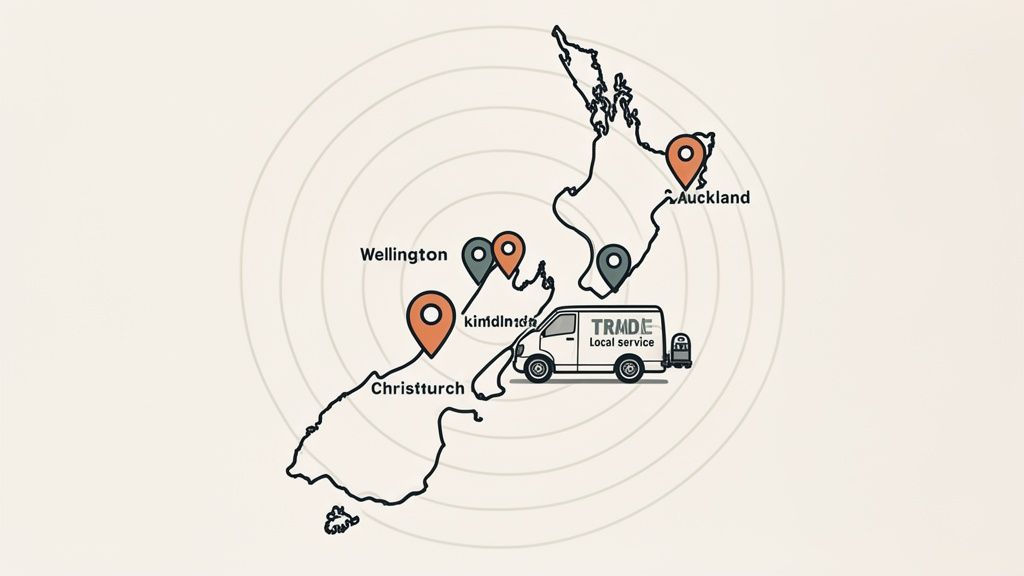
Real-World Posts That Actually Get the Phone Ringing

Theory is one thing, but practical application is what truly matters. When you're flat out on a job site, you need simple strategies that get results, not a bunch of marketing fluff. So, let's break down a few real-world examples of social media posts that Kiwi tradies are using right now to get more calls.

These aren’t complicated ideas. They are practical, effective posts that build trust and showcase what you can do.

A visual flow: social media before-and-after photos, a DIY video, and a safety tip card.

For Builders: The Power of Before and After

For a builder, nothing tells a story better than a good 'before and after' comparison. It’s a dead-simple way to show the quality of your workmanship and the transformation you can deliver, something words alone just can't do.

  • The Post: Use a side-by-side photo, or even a quick video reel. Show the dodgy old deck you started with, then present the flash new outdoor space you’ve just finished.
  • The Caption: Keep it straight to the point. "Great to bring this tired old deck in West Auckland back to life. The family now has a solid, safe space to enjoy for years to come."
  • Why It Works: It’s instant proof of your skills. A potential customer scrolling through their feed doesn’t have to wonder if you’re any good—they can see it right there. This builds immediate trust and makes you the obvious choice for their renovation.

For Electricians: A Simple Safety Tip

As a sparky, your knowledge is your biggest asset. Sharing a quick safety tip shows you’re a professional who cares about the community, not just the next invoice.

Homeowners want to know they’re hiring someone who knows their stuff inside and out. A quick post about testing RCDs or the dangers of overloaded multi-boards shows you’re a knowledgeable expert they can rely on for a safe, compliant job.

  • The Post: A clean, simple graphic with a heading like "Sparky's Safety Tip" next to a photo of a power point works a treat.
  • The Caption: Write a short, easy-to-understand tip. For instance: "Did you know you should test your RCDs every six months? Just hit the 'T' button. If it doesn't trip the power, it's time to call a registered electrician."
  • Why It Works: It builds authority. It positions you as the expert who puts safety first—the number one concern for anyone hiring an electrician. When they have a problem, they’ll remember the helpful sparky they saw online.

For Plumbers: A Video of a Tricky Job Done Right

Let’s be honest, plumbing problems are stressful for homeowners. A short video of you calmly sorting out a difficult job gives them massive peace of mind.

  • The Post: A 30-second clip from your phone is all you need. Maybe it’s you neatly installing new pipework in a cramped space or explaining a common hot water cylinder issue. No fancy editing is required.
  • The Caption: "Sorted a stubborn leak tucked away under a tricky sink in a Christchurch villa today. All fixed up now with new, secure fittings."
  • Why It Works: It demystifies the job and showcases your skill and confidence. For a homeowner staring at a spreading water stain, seeing a video of a calm professional dealing with a similar problem makes calling you a much easier decision.

These examples prove that effective social media management in New Zealand for tradies doesn't need to be complicated. It's all about consistently and clearly showing your skill, reliability, and professionalism.

If you’d rather focus on the tools and let us handle this for you, get in touch for a chat. We're here to help.

How to Measure What Actually Matters

So, you’re putting money into social media management, but how do you know it’s actually paying off? It's a fair question, and one you should definitely be asking. Forget vanity metrics like follower counts – they don't pay the bills. The real measure of success is simple: is your phone ringing more often with genuine, local job enquiries?

Everything we track is geared towards that one single outcome. You should never be left in the dark, wondering what you're paying for or if it's making any difference.

The Numbers That Count for Kiwi Tradies

When we manage your social media, we’re laser-focused on a handful of key performance indicators (KPIs). These are the no-fluff numbers that tell us whether we're hitting the mark and getting the right people to pick up the phone.

Here’s what we keep a close eye on:

  • Local Reach: This is huge. It shows us exactly how many people in your specific service area have seen your posts. Think of it as knowing precisely how many homeowners in your neighbourhood saw your flyer, only far more accurate.
  • Engagement Rate: Are people actually interacting with what you post? We track the comments, shares, and likes to see if your content is connecting with the local community and building that all-important trust.
  • Website Clicks: This one is a biggie. We measure how many people are clicking from your social media profile straight through to your website. That’s where they can see your gallery of work and find your contact number.
  • Direct Messages & Phone Clicks: This is where the rubber really meets the road. We count every potential customer who sends you a direct message for a quote or hits the "Call Now" button on your page.

These are the stats that lead directly to quotes and jobs. Chasing followers from the other side of the country is a waste of time; we are all about generating real leads right in your own backyard.

What a No-Nonsense Report Should Look Like

You deserve to know exactly what’s been done and what came of it. That’s why you should always expect a straightforward, easy-to-read monthly report that gets straight to the point. No fluff, no jargon.

A good report shouldn’t feel like you’re trying to decipher a complex wiring diagram. It should be a clear, one-page summary telling you what we did, how it went, and what the plan is for next month.

Our reports are built for busy tradies. They lay out the essentials so you can see the value at a glance. This way, you're always in the loop and can feel confident that your investment is pulling its weight. At the end of the day, our social media management New Zealand service is judged on one thing: getting you more work.

If you’re ready for an approach that focuses on real-world results, contact us today for a free, no-obligation chat.

Choosing the Right Marketing Partner for Your Business

Picking an agency to handle your online marketing is a big decision. You’re not just hiring a supplier; you’re bringing on a partner. They need to feel like an extension of your own team—someone who understands what you do, speaks your language, and is laser-focused on getting you tangible results.

The right choice means finding someone genuinely invested in helping you win more jobs. To help you feel confident you're making the right move, we’ve put together a no-nonsense checklist. These are the key questions you should be asking any potential agency to make sure they’re the right fit for your trade business here in NZ.

The Essential Checklist for Choosing an Agency

Before you put pen to paper on any contract, run through these questions. A good, honest partner will have clear answers ready to go.

  • Do you have experience working with other tradies? Marketing a plumbing business is worlds away from marketing a local café. An agency that already knows the trades will get up to speed faster because they already understand what your customers are looking for.
  • Can you show me real results for businesses like mine? Don't be shy about asking for proof. They should be able to show you social media pages they manage for other Kiwi tradies and walk you through the actual results they’ve delivered.
  • Who will be my day-to-day contact? You need to know you can pick up the phone and talk to a real person who knows your business, not get bounced around a call centre.
  • How do you measure success? Their answer should be all about things that actually grow your business—quote requests, phone calls, and website clicks. Be wary if they only talk about vague metrics like 'likes' or 'followers'.
  • What does your reporting look like? Ask to see a sample report. It needs to be straightforward, easy to understand, and clearly show you what you're getting for your money.

These questions will help you sort the talkers from the doers. For a more detailed look, you might find our guide on how to choose from the various digital marketing companies in NZ useful.

Red Flags to Watch For

Knowing what to look for is only half the battle; you also need to know what to avoid. Some providers talk a big game, but their promises often fall flat.

Be wary of anyone promising guaranteed overnight results. Building a solid online reputation takes time and consistent effort. There are no magic bullets, and anyone who says otherwise isn’t being straight with you.

Here are a few warning signs that a provider might not be the right fit:

  • Guaranteed #1 Rankings: Nobody can guarantee you the top spot on Google or that you'll go viral on Facebook. This is often just a sales tactic to get you to sign up quickly.
  • Lack of Transparency on Pricing: The costs should be crystal clear from the start. If their quotes are confusing or full of hidden fees, that's a massive red flag.
  • Vague Strategy: If they can't explain their plan for your business in simple terms, it's likely they don't really have one.

Choosing a partner for your social media management in New Zealand comes down to finding a reliable, experienced team you can trust. By asking the right questions and keeping an eye out for these red flags, you can make a smart choice that will help your business grow for years to come.


At Trades Online, we pride ourselves on being the straightforward, results-focused marketing partner for Kiwi tradies. If you’re ready to win more work without the hassle, let’s have a chat about how we can help. https://www.tradesonline.co.nz

Categories
Uncategorized

Choosing the Right SEO Agency NZ for Your Trade Business

Hiring the right SEO agency in NZ is one of the smartest moves a tradie can make to keep a steady flow of work coming in. It's all about making sure your business shows up the moment a potential customer in your area searches Google for a builder in Christchurch or an emergency plumber in Auckland. Working with a reliable team makes this process straightforward, ensuring your online presence is a valuable asset, not a hassle.

Why a Good SEO Agency Is a Tradie’s Best Tool

Think back a few years. If someone needed a sparky or a builder, they’d flick through the Yellow Pages. Today, they just pull out their phone and type what they need into Google. If your business isn’t on that first page of results, you’re essentially invisible to most of your potential customers.

This is exactly where an experienced SEO agency becomes your most valuable tool. A solid SEO strategy is like having your van permanently parked on the busiest street in town, sign-written and ready for the next callout. It’s out there working for you 24/7, ensuring that when someone has a problem you can fix—be it a leaky pipe or a full-on renovation—your business is the first one they find.

Turning Searches into Phone Calls

Let's be clear: the goal of SEO isn't just about getting clicks on a website. It’s about making your phone ring with real enquiries from people in your actual service area.

A specialist SEO agency understands how to connect what you do with the specific phrases customers are typing into Google. They’ll focus on local SEO, which is all about optimising your online presence to show up in the search results for the specific suburbs and towns you want to work in. This approach stops you from wasting time and money on calls from people way outside your region. It’s a targeted method with a single, clear purpose: generating qualified leads that turn into profitable jobs.

Building a Reputation That Works for You

A strong online presence does more than just bring in leads; it builds trust before you’ve even had a chance to speak to the customer. When your website appears at the top of Google, backed by great reviews and a professional look, it instantly makes you seem more reliable and credible. You start to look like the go-to expert in your area.

A steady online presence ensures you’re not just competing for jobs, but building a valuable asset. Your digital reputation becomes a constant source of new business, keeping your pipeline full even during the quieter months.

This digital reputation works away in the background, reinforcing your brand and making it an easy choice for new customers to choose you over the competition. For a practical look at how this works for a specific trade, check out our guide on SEO strategies for plumbers.

Ultimately, partnering with the right SEO agency isn’t a cost; it’s an investment in the long-term growth and stability of your trade business. It frees you up to do what you do best—staying on the tools—while the experts take care of getting you found online.

Ready to see how a dedicated strategy can fill your job book? Let's have a chat about getting your business in front of more local customers.

What to Look For in an SEO Agency That Actually Gets Tradies

Not all SEO agencies in New Zealand are created equal. Many of them are geared towards large corporate clients and don't understand the day-to-day reality of running a trade business. You need a partner who understands that a lead from the other side of Auckland is a waste of time and that your success is measured in phone calls, not just website clicks.

Finding the right SEO crew means cutting through the sales jargon and focusing on genuine, local experience. You're not just hiring someone to tinker with your website; you're bringing on a team member whose job is to get you more work. It’s that simple. Their ability to understand your business and your customers is what makes all the difference.

Think about how customers find you these days. It's not like the old Yellow Pages anymore.

As you can see, after a quick Google search, your website is the final stop where a potential customer decides whether to pick up the phone.

Proven Experience with Kiwi Tradies

First things first, you should check their track record. Have they actually worked with builders, sparkies, or plumbers here in New Zealand? Don't be shy—ask to see case studies or examples of other tradie websites they’ve helped rank.

A good agency will be proud to show off their work. They should be able to point to specific Kiwi trade businesses they’ve helped and explain the results in plain English, like a 30% jump in quote requests for a plumber in Hamilton.

Vague testimonials from a retail shop or a software company are pretty much useless to you. You need solid proof they understand your industry and know what it takes to make the phone ring for a tradesperson. This is not a "nice-to-have"; it's a deal-breaker.

A Deep Understanding of Local SEO

For any tradie, 'local' is the name of the game. If an agency starts talking about national or international rankings, they're completely missing the point. You need a team that lives and breathes local SEO, focusing on getting you found in the specific suburbs and towns you actually service.

This means their strategy should be all about:

  • Google Business Profile Optimisation: Dialling in your profile so it’s perfect, getting you right at the top of the Google Maps results.
  • Localised Content: Building out pages on your site that target specific areas, like "electrician Pukekohe" or "roofer Tauranga."
  • Citation Building: Making sure your business name, address, and phone number are listed consistently and correctly across all the important NZ online directories.

These are the fundamental elements that signal to Google you’re the go-to expert in a particular patch. It’s a specialised skill, and it’s what separates the real experts from the generalists. If you want to dig deeper, you can learn more about the different types of digital marketing companies in NZ and what they specialise in.

Transparent Communication and Reporting

A trustworthy agency will never hide behind confusing tech-speak. They should be able to explain what they’re doing and show you the results in a way that makes sense. We’re talking about metrics that actually impact your bottom line—phone calls, contact form submissions, and real leads—not just a list of keyword rankings.

The global SEO market is massive, and it’s being driven by small businesses just like yours. In fact, small and medium businesses are the biggest players, making up 58.40% of the entire market. This trend mirrors what we see right here in New Zealand. Finding a partner who understands that is absolutely critical.

The SEO Services Your Trade Business Actually Needs

Let's be honest, wading through the different services an SEO agency in NZ offers can be a real headache. There’s a lot of jargon and flashy promises. But to get the best results for your trade business, you don't need every bell and whistle under the sun.

What you need is a sharp, focused plan that gets your phone ringing with actual quote requests from your local area. A generic, one-size-fits-all approach just doesn't cut it for tradies. You need a strategy built around your specific trade and the suburbs you actually work in, ensuring you attract good-quality leads, not just random website traffic from people who are too far away.

Local SEO: The Foundation for Getting Found

For any Kiwi trade business, local SEO is the absolute cornerstone of your online marketing. It’s the nuts and bolts of getting your business to show up when a potential customer searches for "emergency plumber near me" or "builder in West Auckland."

The main goal here is to get you ranked in the Google 'Map Pack'. You know, that box with three local businesses that pops up right at the top of the search results? Landing a spot there is like gold—it puts your business front and centre for customers who are ready to hire someone now.

To get this right, a decent agency will zero in on:

  • Your Google Business Profile: This is your digital shopfront. A good agency will completely optimise it with your correct service areas, hours, photos of your work, and help you get a steady stream of positive reviews.
  • Location-Specific Keywords: They'll do the homework to figure out exactly how customers in your patch search for your services and build a plan around those specific phrases.

On-Page SEO: Making Your Website Make Sense to Google

Once a customer finds you, your website needs to instantly tell them they’re in the right place. That's where on-page SEO comes in. It’s all about structuring your site's content and technical aspects so Google understands exactly what you do and where you do it. In short, it’s about making your website easy to use for both people and search engines.

This isn't just about stuffing keywords onto a page. It's about creating a clear, helpful experience for your visitors that encourages them to become a lead. The easier you make it for a customer to find what they need and contact you, the more likely they are to pick up the phone.

A clean, fast, and well-organised site signals quality to Google, which directly boosts your rankings. For more on how your website's layout can influence customers, have a look at our guide on the importance of great UI/UX design.

Citation and Link Building: Building Your Authority

The last crucial piece of the local SEO puzzle is building citations. This is just a way of saying they’ll get your business name, address, and phone number (NAP) listed consistently across reputable New Zealand online directories like Yellow or Finda.

When your details are consistent everywhere, it builds trust with Google and reinforces that you're a legitimate, established local business. Think of each citation as another vote of confidence in your company's credibility.

In New Zealand, Google's influence is massive—it holds 92.66% of the search engine market share. This complete dominance means every SEO effort has to be geared towards what Google values most: authority, relevance, and a strong local presence. To get a better handle on the core services that achieve this, understanding the top local SEO services for small businesses is a great place to start.

Common Red Flags to Watch Out For

The digital marketing world certainly has its share of cowboys. When you’re looking for an SEO agency in NZ, you’ll come across plenty of providers who talk a big game but can’t actually deliver the goods. Learning to spot the warning signs is the best way to protect your investment and avoid getting burned.

A reliable partner will be upfront, realistic, and focused on your business goals. A bad one, on the other hand, will often rely on hype and pressure to get you to sign on the dotted line. Being able to tell the difference is crucial.

Unrealistic Promises and Guarantees

This is a significant one. If an agency guarantees you a #1 ranking on Google, you should walk away. Let’s be perfectly clear: no one can honestly promise this. Google's algorithm is a complex system that’s always changing, and where you rank depends on dozens of factors—including what your competitors are up to.

A professional agency will talk about steady growth, better visibility in your local service areas, and an increase in qualified leads through your website. They'll set expectations based on real data and years of experience, not unrealistic promises.

Any agency offering a "guaranteed number one spot" isn't being straight with you. They’re either using risky, short-term tactics that could get your site penalised by Google, or they're simply telling you what you want to hear to close the deal.

Secret Strategies and Technical Jargon

If an agency can't explain what they're doing in plain English, that’s a problem. Some providers hide their lack of a real strategy behind a smokescreen of confusing tech-speak, talking about their "secret sauce" or "proprietary methods." This is often a sign of inexperience.

Your SEO partner should be able to clearly walk you through what they plan to do and why it will help your business get more calls. A focus on jargon instead of real-world results is a massive warning sign. They’re more interested in sounding smart than delivering actual value to your business.

Long, Inflexible Contracts

Be very wary of any agency that tries to lock you into a 12-month or longer contract from day one, especially if there’s no clear way out. A confident agency knows they need to earn your business every single month by delivering results you can see.

SEO does take time to gain momentum, which is understandable. However, a fair agreement will usually have an initial commitment of a few months, after which it might switch to a more flexible month-to-month plan. This shows they’re confident in their ability to deliver and keep you as a happy client, without needing to trap you in a long-term deal.

If you’re ready to partner with a straightforward team that focuses on real results, get in touch for a free, no-obligation chat.

Our Approach to SEO for Kiwi Tradies

Look, you're a master of your trade, not a digital marketing expert. And that's exactly how it should be. You’re busy on the tools, delivering top-notch work for your clients. Our job is to handle the online side of things, making sure a steady stream of local customers finds you when they need your skills the most.

Our approach is straightforward because good marketing for tradies doesn't need to be complicated. We have built our entire service around what Kiwi tradies actually need. That means we ditch the corporate jargon and focus only on the strategies that get your phone ringing and put qualified leads in your inbox.

We've been doing this long enough to know what works—and what doesn't—for a business like yours. Too many agencies use a cookie-cutter approach for every client, but a sparky in Christchurch has completely different needs to a large retail chain. That's why our process always starts with getting to know your trade, the types of jobs you want, and the specific suburbs you want to dominate.

A Clear and Simple Process

We understand you're flat out, so we keep things simple. Our process is designed to be completely transparent, giving you a clear picture of what we’re doing and, more importantly, why we’re doing it.

We handle everything, from the first deep dive into your website's health to the ongoing work it takes to climb the local search rankings.

Here’s a quick rundown of our usual workflow:

  • Initial Website Audit: First up, we give your current site a full health check to see where it might be letting you down and losing you leads.
  • Local Keyword Strategy: We find out exactly how potential customers in your area are searching for your services and build a plan around those terms.
  • On-Site Optimisation: We get under the bonnet and sort out all the technical basics, making sure your website is perfectly set up for Google to find and understand.
  • Ongoing Local SEO: This is the consistent, quality work that builds your authority in your key service areas and keeps the leads coming in.

Reporting on What Actually Matters

The digital marketing software market in New Zealand is valued at around USD 1.3 billion, which means even small trade businesses can access some seriously powerful tools. But tools are useless without the right strategy.

A lot of agencies get hung up on "vanity metrics" like website traffic. It might look good on a graph, but it doesn't pay the bills.

Our reports cut straight to the chase. We focus on the only things that truly matter to a trade business: the number of phone calls, quote requests, and contact form submissions you get.

That’s how you measure the real return on your investment. We connect our work directly to these tangible results, so you can see exactly how our efforts are fuelling your growth. It’s all about turning your website into a reliable source of new work. For more on this, check out our guide on New Zealand online marketing for tradies.

If you’re ready to partner with an SEO agency in NZ that truly gets the trades, we're here to help. Get in touch for a free, no-obligation look at your website, and we’ll show you exactly where you can start winning more local jobs.

Your SEO Questions Answered

When builders, plumbers, and sparkies across New Zealand first give us a bell, they often have the same handful of questions. That’s completely fair enough. You want straight answers before you spend your hard-earned cash, so let’s get right into the most common ones we hear.

How Much Should a Tradie Pay for SEO in NZ?

SEO pricing can vary quite a bit, but for a local trade business, it’s best to view it as a monthly investment in getting more work. Our honest advice is to be very wary of anything that sounds too cheap. Rock-bottom prices often mean corners are being cut, and that can end up costing you more down the track.

A decent SEO agency in NZ will provide a clear, simple package price based on your trade and what you want to achieve. The real key is to weigh the cost against the return. If just one or two good jobs landed through your website covers the monthly fee, you're already making a profit.

How Long Until I Actually See Results?

This is a very common question, and we'll be upfront: SEO is a long game, not a quick fix. You might see some small wins in the first 1-3 months as the technical elements are sorted, but you’re typically looking at around 4-6 months to see a proper lift in your rankings and, more importantly, in the phone ringing.

Any agency promising you instant number one rankings isn't being realistic. The goal isn't a short-term sugar rush; it's about building steady, sustainable growth that keeps the jobs rolling in for years to come.

What Should the Reports Look Like?

Your reports should be straightforward and focused on what actually matters to your business. Seeing your keyword rankings go up is nice, but it doesn't pay the wages. The only numbers that really count are the ones that show real growth.

Here’s what you should be tracking:

  • How many phone calls came directly from the website.
  • How many quote requests or contact forms were filled out.
  • The increase in website visitors from your specific service areas.

A good agency will tie their efforts directly to these outcomes. That way, you know exactly what you’re getting for your money.


At Trades Online, we keep it simple and focus on what fills your job book. If you're tired of the jargon and just want more work, let's have a chat. Book a free, no-obligation strategy session with us today and we'll show you how we can help.

Categories
Uncategorized

Clear Website Design Pricing for NZ Tradies

So, how much does a website actually cost for a tradie in New Zealand?

Let's get straight to it: you’re likely looking at a range between $1,500 and $6,000 + GST. Where your project lands within that bracket really depends on what you need your site to do for your business and how many pages it requires. For most tradespeople, a clean, effective website that brings in local work is one of the best investments you'll ever make.

How Much a Tradie Website Really Costs in NZ

When you’re flat out on the tools, you don’t have time for confusing quotes and technical jargon. You just want a straight answer, the same way you’d provide a quote to a client for a job. The good news is that getting a professional website sorted doesn’t have to be a headache or cost a fortune, and we're here to make the process straightforward and calm.

Most Kiwi tradies—plumbers, builders, electricians, and painters—share the same primary goal for their online presence. You need a professional online shopfront that showcases your work, builds trust with potential customers, and makes it incredibly simple for them to call you. You're not trying to build the next Amazon; you just need a solid, reliable workhorse that gets your phone ringing with genuine enquiries.

A Quick Look at Common Website Packages for NZ Tradies

To make things clearer, here’s a breakdown of the typical website packages you’ll come across. This should help you figure out where your business fits and what a realistic budget looks like for achieving your goals.

Package Type Best For Common Features Typical Price Range (NZD)
Basic (Starter) Solo tradies or small crews just getting started online. • 3-5 pages (Home, About, Services, Contact)
• Mobile-friendly design
• Contact form & click-to-call
• Basic SEO setup
$1,500 – $3,000
Standard (Growth) Established businesses looking to grow their local customer base. • 5-10 pages with a project gallery
• On-page SEO for multiple services
• Blog setup for sharing tips
• Google Business Profile integration
$3,000 – $6,000
Advanced (Custom) Larger companies or those in competitive markets needing an edge. • 10+ pages with custom features
• Advanced SEO strategy
• Online booking/quoting system
• E-commerce for selling products
$6,000+

As you can see, the investment grows with the complexity of the project. However, for most tradies, the Basic or Standard packages contain everything you need to get a steady stream of leads coming into your business.

Understanding the Price Brackets

For a simple, sharp-looking website that showcases your services and past projects, you're usually looking at the lower end of the scale. Industry figures show that builders and plumbers in New Zealand can get a fantastic site for around $1,500 to $3,000. For many owner-operators, a site in this range is a powerful, affordable tool that quickly pays for itself through new work.

This diagram gives you a visual idea of how the pricing tiers stack up.

The more features and customisation you add, the more it costs. It’s that simple. The trick is to figure out what you actually need to achieve your business goals, and that's something we can help with.

Finding the Right Fit for Your Business

The key is to match your budget to your business needs, not just buy the flashiest option available. Not every tradie needs a top-of-the-line, custom-built machine. More often than not, a clean, professional, and mobile-friendly website that clearly says who you are and what you do is far more effective.

Think of it this way: a great website should work as hard as your best apprentice—reliably bringing in new jobs while you focus on getting the work done. It’s a tool, not just an expense.

At the end of the day, it's all about the value it brings back to your business. A well-built site generates new leads and strengthens your reputation, paying for itself many times over. Before you sign on the dotted line, it's worth checking out a few digital marketing companies in NZ to find a partner who genuinely understands the trades.

What Actually Goes Into Your Website Quote?

Ever looked at two website quotes and wondered why one is double the other? It’s not just a number pulled from thin air. The process is a lot like pricing up a building job – the final cost comes down to the scope, the materials, and how complex the project is. Understanding these moving parts helps you see exactly what you're paying for.

When a web designer puts together a quote, we're not just guessing. We’re carefully looking at several key elements that build the final price. This detailed approach ensures you get a tool that’s actually built for the job, not some generic template that won't get your phone ringing.

Let's lift the bonnet and have a look at what really drives the cost.

The Core Building Blocks of Your Quote

The foundation of any decent website quote boils down to a few critical things. The more time, skill, and resources needed for each element, the more it will cost. It’s a bit like choosing between a standard work ute and one with all the bells and whistles—both get you to the job site, but one has a lot more capability.

These are the main drivers:

  • Number of Pages: A simple five-page site (Home, About, Services, Gallery, Contact) is a lot quicker to build than a 15-page site with a separate page for every single service you offer. More pages mean more design, writing, and development time.
  • Custom vs Template Design: A template is like a pre-built frame—it’s faster and cheaper, but it won't be unique. A custom design is like getting an architect to draw up plans just for your business. It creates a much stronger brand and a better experience for your visitors, which almost always leads to more enquiries.
  • Content Creation: Do you already have professional photos of your work and well-written text ready to go? If not, the quote will likely include time for a copywriter to craft the words and for sourcing quality images to make sure your business looks the part.

Features and Functions That Add Real Value

Beyond the basic structure, certain features can add some serious horsepower to your site. Think of these as the specialised tools in your kit—each one is designed for a specific task that helps you win more work. Adding this sort of functionality requires expert setup, which naturally influences the price.
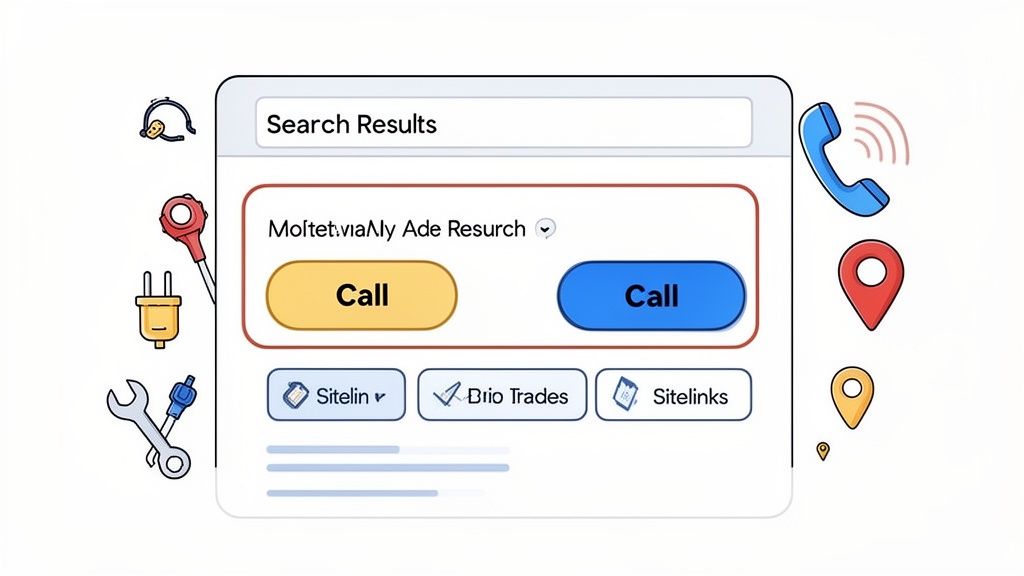
For example, across New Zealand, website design pricing can be all over the place. But for a professional 5-10 page site for a tradie, you’re typically looking at a range between $1,500 and $6,000. That sweet spot gets you a mobile-friendly powerhouse with the right features to turn visitors into phone calls, without the pointless complexity of a massive corporate site.

A website's price isn't just about how it looks; it's about what it does. Key features like online booking, quote request forms, and integrated customer reviews are what turn a simple online brochure into a 24/7 lead-generation machine.

Common features that will affect your quote include:

  • Online Booking or Quoting Forms: Letting customers request a quote or book a time straight from your site adds a bit of complexity, but it’s a game-changer for capturing leads.
  • Photo and Video Galleries: A sharp, well-organised gallery showing off your workmanship is absolutely essential for building trust with potential clients.
  • Customer Review Integration: Automatically pulling in your latest 5-star Google or Facebook reviews builds instant credibility. When you're budgeting, think about the costs of integrating these tools. For example, you might want to look at Embedsocial's pricing structure to see how these services fit into your overall investment.
  • Search Engine Optimisation (SEO) Foundations: This isn't an optional extra; it's crucial. A proper SEO setup from the start ensures your site is built to be found on Google when locals are searching for the services you offer.

Once you get your head around these different parts, you can have a much more confident chat with any web designer. You’ll know what to ask for and can make sure your investment is going into the features that will actually help grow your business.

Comparing One-Off vs Monthly Website Plans

When you're looking at getting a new website, you’ll quickly find there are two main ways to pay for it: a one-off project fee or a monthly plan. There's no single "best" way; the right choice really boils down to your business's cash flow, what you want to achieve, and how much you want to be involved after the site goes live.

Let's put it in terms a tradie understands. A one-off payment is like buying your tools outright. You pay a lump sum, and they're yours to own and maintain forever. A monthly plan is more like leasing your ute—the upfront cost is much smaller, and your regular payments cover all the running costs like maintenance, security, and updates.

The One-Off Project Fee Approach

Paying for your website in one go is the traditional way of doing things. You and the developer agree on a price, they build the site, you pay the final bill, and it’s all yours. This definitely appeals to tradies who like to pay for something once and just be done with it.

The big drawcard here is straightforward ownership. You own the asset, and you don’t have any more payments for the design and build. However, and this is an important point, it doesn't mean your website is free to run from that point on.

Even with a one-off build, you'll still have ongoing costs for:

  • Website Hosting: Think of this as the rent for your website's spot on the internet. It’s an absolute must-have.
  • Domain Name Renewal: Your web address (e.g., yourbusiness.co.nz) needs to be renewed every year, or you’ll lose it.
  • Ongoing Maintenance: This is the big one. Software needs updating, security needs checking, and backups are crucial. If you neglect this, your site can slow down, get hacked, or simply break.

With a one-off project, you're responsible for sorting all of this out yourself, or paying a developer's hourly rate every time you need something done.

The Monthly Plan or "Website as a Service" Model

A monthly plan, on the other hand, rolls the initial website build and all that technical upkeep into one, predictable payment. Instead of a hefty upfront cost of, say, $4,000, you might pay a small setup fee and then a flat amount each month.

This "Website as a Service" approach is becoming very popular with Kiwi tradies, and for good reason. It turns a big capital expense into a manageable operating cost, which is a whole lot easier on the bank account.

A monthly plan gives you peace of mind. It ensures your website—your hardest-working salesperson—is always secure, up-to-date, and performing at its best, without you having to lift a finger or worry about surprise technical bills.

For most of our clients, this model is the perfect fit. It gets a top-notch, professional website up and running quickly without needing a huge chunk of cash upfront. The ongoing support means they can get on with their actual jobs, knowing their online presence is in good hands. A lot of these plans also include ongoing SEO work, which you can learn more about from a good SEO agency in New Zealand.

At the end of the day, the right pricing model is all about your business. If you’ve got the capital ready to go and you're happy to manage the ongoing bits and pieces yourself, a one-off fee can work great. But if you'd rather have predictable costs, zero maintenance headaches, and continuous support, a monthly plan is often the smarter, stress-free way to go.

Why the Cheapest Quote Can Cost You More

We all love a good deal, and when you're running a business, keeping an eye on the bottom line is just common sense. So, when a super-low quote for a new website hits your inbox, it’s natural to feel tempted.

However, when it comes to your website, going for the cheapest option often ends up costing you a whole lot more down the track. It’s like using dodgy, cheap materials on a job—it might look alright for a week, but you know you’ll be back fixing it sooner rather than later. A rock-bottom price usually means corners are being cut, and these shortcuts lead to lost work, frustrated customers, and hefty bills to fix what should have been done right the first time. Your website is your hardest-working salesperson, operating 24/7. A bit more investment upfront for a quality build is one of the smartest moves you can make.

The Hidden Costs of a "Cheap" Website

Let's be clear: a cheap website and a good value website are two very different things. That initial saving often gets swallowed up by what’s missing under the bonnet. These aren't just small issues; they're fundamental flaws that can stall your business growth and even tarnish your reputation.

A low price tag is a red flag that you're likely missing out on these critical features:

  • Weak Security: Cheap sites often skimp on essential security, making them an easy target for hackers. A hacked site can get blacklisted by Google, destroy customer trust, and cost a small fortune to clean up.
  • No Mobile Optimisation: Most Kiwis are searching for tradies on their phones. If your site is a mess on mobile, it’s pretty much useless. If a potential customer has to pinch and zoom just to find your number, they’ll give up and call the next person on the list.
  • Invisible on Google: The cheapest quotes almost never include proper Search Engine Optimisation (SEO). This means your website is built without the technical foundations Google needs to find and rank it. You’re left invisible to customers actively searching for your exact services.

Think of it like this: A cheap website is like having a brilliant sign for your business but sticking it in a locked shed where no one can see it. It might look nice, but it's not doing a single thing to bring you work.

Long-Term Problems and Lost Opportunities

The headaches don't stop there. A cheap site is often built on a clunky, inflexible system that’s a nightmare to update, which means you’re stuck. If you want to add new photos of your latest job or update your list of services, you’ll likely have to pay a developer’s hourly rate for even the simplest changes.

But the biggest issue is that a poorly built site fails at its most important job: turning visitors into leads. Slow loading times are a classic problem; studies show 40% of users will abandon a website that takes more than three seconds to load. Every person who clicks away is a potential job lost to a competitor whose site gave them a faster, better experience.

Investing in Quality Is Investing in Leads

Choosing a slightly higher, more realistic website design price isn't just another expense—it's an investment in the future of your business. A professionally built website is designed from the ground up to attract customers and make it dead simple for them to get in touch.

It’s secure, fast, and works perfectly on mobile phones. Most importantly, it has the right SEO foundations built in from day one, so you actually start showing up in local Google searches. This means more phone calls, more quote requests, and a steady stream of work that lets you focus on what you do best.

Ready to invest in a website that actually works for you? Let's have a chat. We can run a free audit on your current site or talk through what a high-performing new website could do for your business. We offer straight, honest advice with no pressure.

What Every Tradie Website Absolutely Must Have

A good website for a tradie is more than just an online business card – it's your hardest-working employee, designed to build trust and bring in jobs 24/7. To make sure your site is actually pulling its weight, it needs a few non-negotiable elements.

Think of these features as the foundations of a high-performing site. Together, they show potential customers you’re a professional, you’re great at what you do, and you’re the right choice for the job. Without them, even a flash-looking website will fall flat when it comes to generating consistent work.

H3: Straight-Up, Simple Service Descriptions

When a homeowner lands on your site, they need to know what you do and where you do it, instantly. Don't make them dig around for the basics.

Your services should be laid out in plain English, avoiding confusing industry jargon. Instead of just saying “Plumbing Services,” break it down into things people actually search for, like “hot water cylinder repairs,” “leaky tap fixes,” or “drain unblocking.” This not only helps your customer but also helps Google figure out what you’re all about, making it easier for locals to find you.

H3: A Gallery Showcasing Your Best Work

For any tradie, your work is your best sales pitch. A gallery of high-quality photos showing off your finished projects is hands-down one of the most powerful ways to build trust and prove your skills. Nothing sells you better than the work itself.

Whether you're a builder showing off a new deck, a sparky displaying a clean switchboard install, or a painter with a crisp exterior finish, these images give potential customers a real feel for the quality you deliver. Make sure your photos are clear and well-lit. This visual proof is often the final nudge someone needs to choose you over the competition.

Your website's gallery isn't just a collection of photos; it's your digital portfolio. It provides tangible evidence of your skill and professionalism, allowing potential customers to visualise the quality of your work in their own home or project.

H3: Real-Deal Customer Reviews and Testimonials

What other people say about you carries a lot more weight than what you say about yourself. Weaving genuine customer reviews and testimonials into your site is a game-changer for building instant credibility.

It’s one thing to claim you do a great job; it's another thing entirely when a happy customer says it for you. Short, punchy quotes from past clients, maybe with their first name and suburb, feel authentic and reassure new visitors that you’re a reliable professional who gets the job done right.

Essential Website Checklist for Tradies

Here’s a quick checklist to make sure your website has all the core features needed to attract and convert customers here in New Zealand. These elements are the building blocks of a great user experience.

If you're keen to dive deeper into why this stuff matters, it's all about good UI and UX design for websites.

Feature Why It's Important Included in Our Packages?
Mobile-Friendly Design Most customers will find you on their phone. Your site must look and work perfectly on a small screen. Yes, always.
Click-to-Call Button Makes it incredibly easy for mobile users to contact you with a single tap. No mucking around. Absolutely.
Simple Enquiry Form A straightforward form for requesting a quote removes hassle and encourages more enquiries. Of course.
Prominent Contact Details Your phone number and email should be highly visible on every single page. Don't make people hunt. Standard practice.

Getting these basics right is crucial. They are small details that make a massive difference in turning a website visitor into a paying customer.

H3: Can't-Miss Contact Information

This might be the most important point of all: your contact details must be impossible to miss. Your phone number should be right there at the top of every page, and your contact page should have your number, email, and a simple enquiry form ready to go.

The goal is to make it dead simple for a potential customer to get in touch. If they have to search for how to call you, they’ll probably just give up and go elsewhere. A clear, direct instruction like “Call Now for a Free Quote” tells them exactly what to do next and turns their interest into a proper job lead.

Getting a Clear Website Quote for Your Business

Alright, you've got a good handle on what goes into website pricing and what a decent tradie website needs to actually get your phone ringing. The next step is a simple one: getting a clear, no-nonsense quote tailored for your business.

We believe this part should be dead easy and transparent. No confusing jargon, no hidden fees. It all kicks off with a quick, no-obligation chat about where you want your business to go.

Our Straightforward Quoting Process

We’ve worked hard to make our process quick and painless because we know you’d rather be on the tools than stuck in meetings. You won't find any long, complicated forms here. It's just a conversation to figure out what you actually need.

Here’s what you can expect when you reach out:

  • A Quick Yarn: We’ll have a chat about your trade, what you do, and who your ideal customers are.
  • Honest Recommendations: Based on that, we’ll give you practical advice on what your site needs to hit those goals. We won't try to sell you flashy extras you don't need.
  • A Firm, Clear Quote: You’ll get a detailed quote that spells out everything we’ll do, along with a fixed price. What we quote is what you pay. Simple as that.

Our promise is a firm, upfront quote so you know exactly what you’re getting into from day one. No hidden costs, no last-minute surprises—just one clear price for a website that works.

Making It Easy to Move Forward

Getting a new website can feel like a big deal, and we understand that. Our job is to make it feel less like a massive project and more like adding another dependable tool to your ute. We handle all the technical stuff behind the scenes so you can keep your focus on your clients.

Interestingly, adding a website quote generator to your own site down the track can be a great way to bring in good leads by giving potential customers instant price estimates.

Once you give our quote the green light, we get straight to work and keep you in the loop every step of the way. As an experienced NZ-based team, we’ve helped countless tradies all over the country get online and win more work. Our entire service is built around being reliable and making things easy for you, from our first chat to the day your new site goes live.
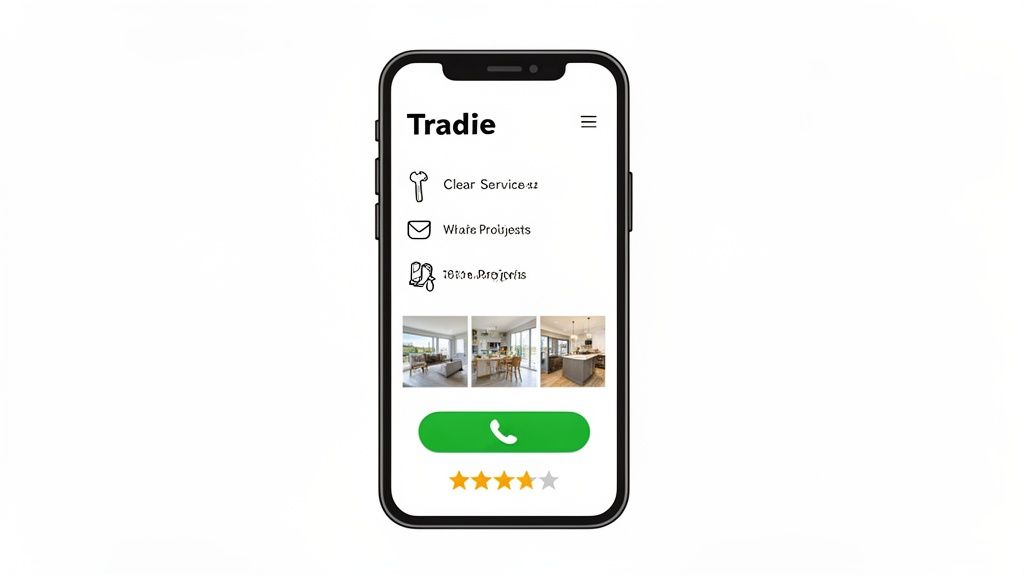
Ready to get a website that actually brings in more jobs? Let’s have a yarn. We’re here to answer your questions and give you a no-pressure quote for a site that lets you get back to doing what you do best.

Common Questions About Website Pricing

I understand that talking about website pricing can feel a bit like navigating a maze. To help clear things up, here are some straight-up answers to the questions we hear most often from Kiwi tradies.

No fluff, just the information you need.

How Long Does It Take to Build a New Website?

For a solid, professional website for a trade business, you should plan for a turnaround of 4 to 6 weeks. That's a realistic timeframe that allows us to do the job right—from our first chat about your business to the final checks before we flick the switch and go live.

This window covers all the important steps: consultation, design mock-ups, getting your content sorted, the actual build, and your final review. If you come to the table with all your photos and service descriptions ready to roll, we can sometimes speed things up. But our main focus is always on getting a quality site online that generates leads, without ever cutting corners.

Do I Need to Supply the Text and Images?

It’s always a huge plus if you have good, high-quality photos of your work. Nothing builds trust faster than showing off your actual projects. But don't worry if your photo library is a bit thin; we can help.

Our packages include professional copywriting, so your services are explained in a way that resonates with customers and ticks all the right boxes for Google. As for images, we can either point you in the right direction for taking great shots yourself or source high-quality, professional stock photos that fit your trade perfectly. Honestly, the best sites usually have a mix of both.

Your website is your digital storefront, open 24/7. Having clear, professional images and well-written descriptions is like having a clean, well-organised showroom—it instantly tells customers you’re a pro who cares about quality.

What Are the Ongoing Costs After the Site Is Built?

Once the one-off build cost is covered, your only ongoing costs are for hosting and maintenance. Just think of hosting as the rent you pay for your website’s address on the internet; it’s what keeps it live and visible.

Maintenance is just as important. This covers all the behind-the-scenes work, like keeping your site’s software updated, protecting it from hackers, and running regular backups. We roll all of this into simple monthly plans so you never have to stress about the tech side of things. It's peace of mind, knowing your site is fast, secure, and working for you around the clock.

Will My New Website Work on a Mobile Phone?

Absolutely. In this day and age, it’s not even a question. A massive chunk of your potential customers are looking for you on their phones, often while they're on the go and need someone urgently.

Every single website we build is "fully responsive." That's just the technical term for a site that automatically resizes and rearranges itself to look great and work flawlessly on any device—desktops, tablets, and especially smartphones. It’s crucial for keeping visitors happy and is a huge factor in how well you rank on Google.


Hopefully, this guide has given you a much clearer picture of what’s involved with website pricing. Getting a professional online presence is one of the smartest investments you can make for your business.

If you’re ready for a website that not only looks sharp but also brings in a steady stream of local work, Trades Online is here to help. Let’s have a quick, no-pressure chat about what a high-performing website could do for you.

Get Your Free Website Assessment and Quote Today

Categories
Uncategorized

A Tradie’s Guide to PPC New Zealand

For a Kiwi tradie trying to line up more jobs and get the phone ringing, Pay-Per-Click (PPC) advertising is one of the quickest ways to get in front of local customers. As an experienced digital marketing company based right here in New Zealand, we've helped countless tradesmen use this tool effectively. Think of it as securing a prime spot on Google, where you only pay when someone who is genuinely looking for your skills clicks your ad.

Why PPC Matters for Kiwi Tradies

If you're a builder, plumber, or sparky, you understand the waiting game all too well. Relying solely on word-of-mouth or waiting for your website to slowly climb the search rankings can feel like watching paint dry. PPC, which is usually run through Google Ads, lets you jump the queue and land right at the top of the search results page. It's essentially a digital billboard, but one that appears precisely when someone types "emergency plumber Christchurch" or "builder for renovations Auckland" into their phone. This immediate visibility is what makes PPC such a powerful and reliable tool for generating leads for your business.

Immediate and Targeted Results

Unlike old-school marketing or even Search Engine Optimisation (SEO)—which can take months to show tangible results—a well-managed PPC campaign can start bringing in calls almost immediately. Its real strength lies in its precision. You're not just shouting into the void; you are placing your business directly in front of homeowners and businesses at the very moment they need a professional. This targeted approach provides a number of clear advantages.

  • Reach Motivated Customers: Your ads appear for people actively looking for the exact services you offer. This means they’re often ready to make a call and hire someone.
  • Control Your Spending: You set a daily budget and only pay when someone is interested enough to click. This puts you in the driver's seat of your advertising spend, ensuring there are no surprises.
  • Measure Your Success: Every single click, call, and quote request can be tracked. You will know precisely what you are getting back for every dollar you invest, allowing for clear, data-backed decisions.

Keeping Up with the Market

The way Kiwis find tradies has changed significantly. New Zealand's digital advertising market recently hit NZD $847 million in a single quarter, and small to medium-sized businesses now account for 43% of total digital ad spending. This is a clear signal that more and more tradesmen are moving online to find work. By embracing PPC, you ensure your business remains competitive and captures the attention of potential clients before others do. It’s a vital part of any modern marketing strategy. You can get a better handle on building your digital footprint in our guide to New Zealand online marketing.

How to Set a Smart PPC Budget That Works for You

A brown wallet with gold coins and a Google Ads daily budget chart showing an upward trend.

Let's get straight to the point: "How much is this actually going to cost me?" It's the first question every tradie asks, and rightly so. The good news is, you don't need a bottomless pit of cash to achieve real results with PPC in New Zealand. It's about being strategic and consistent. The entire system is designed to give you full control. You decide on a daily budget—an amount you are comfortable with—and Google will stick to it. They won't charge you more than your monthly spending limit, which is simply your daily budget multiplied by the average number of days in a month. This means no unexpected expenses on your bill.

Understanding the Cost Per Click

At the heart of the system is the Cost-Per-Click (CPC). This is the amount you pay whenever someone clicks on your advertisement. It works like a silent auction, where you are bidding for a potential customer's attention against other local businesses. Several key factors determine the price of a click here in NZ.

  • Your Trade: Some industries are naturally more competitive. An emergency plumber, for example, will likely pay more per click than a painter because the jobs are often urgent and high-value.
  • Location: Trying to gain visibility in central Auckland will cost more than in a smaller town like Gore. More competition in a given area means higher bids are required.
  • Ad Quality: This is your secret weapon. Google actually rewards well-structured, relevant ads with a higher "Quality Score," which can in turn lower your CPC. A well-written ad can help you secure a better position for less money.

It is a common myth that whoever throws the most money at Google Ads gets the top spot. In reality, Google’s auction prioritises relevance. A top-notch, targeted ad with a sensible bid can easily outperform a poorly constructed ad with a huge budget.

Starting with a Sensible Budget

So, where should you begin? It’s best to avoid investing thousands of dollars from day one. Our experience shows that the most effective approach is to start with a modest, consistent daily budget that allows you to gather data without financial strain. For most local tradies, a daily budget of around $20 to $50 is an excellent starting point. This is enough to collect meaningful data on what’s working without taking a significant financial risk.

Think of it this way: an electrician in Christchurch might set a $30 daily budget. If their average CPC is $3, that provides 10 potential customers clicking through to their website every single day. If just one of those clicks turns into a decent-sized job, the ads have already paid for themselves many times over. Once you see that positive return, you can confidently begin to increase the budget to bring in even more work. The formula is simple: start small, measure everything, and scale up what works.
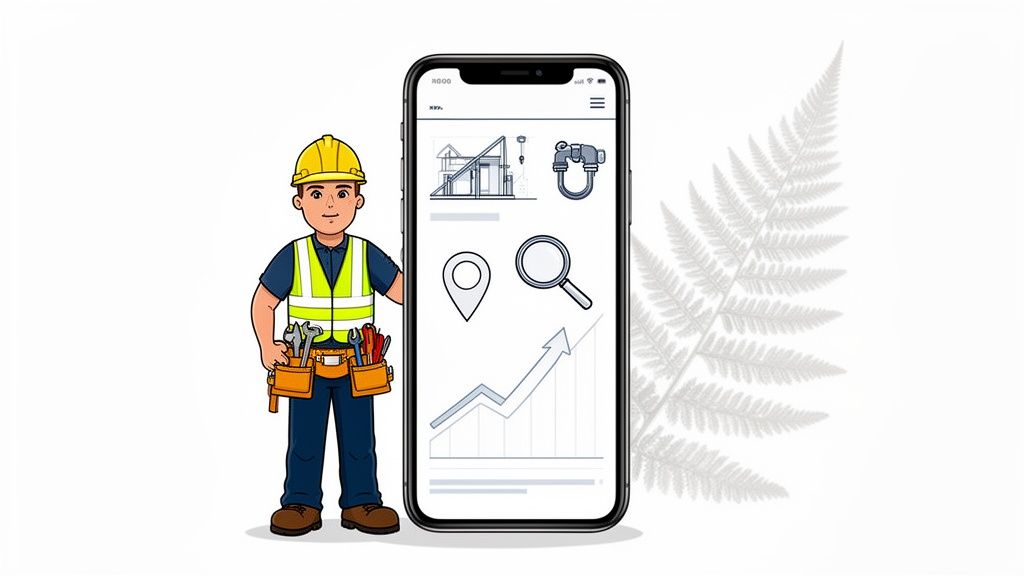
Ready to figure out a budget that makes sense for your business? We can help you put a practical plan together that gets you results without breaking the bank. Get in touch with Trades Online today for a no-obligation chat about your goals.

Winning Local Jobs by Targeting the Right Customers

Map of New Zealand showing service locations in Auckland, Wellington, and Christchurch with a local service van.

The true power of a Google Ads campaign for any Kiwi tradie is its laser-sharp local targeting. Let's be honest, getting a call for a job in Dunedin is a complete waste of your ad budget if you're based in the Waikato. The entire point of this service is to get your ads in front of potential customers who are actually within your service area. This precision is what makes PPC so cost-effective. You stop spending money on clicks from people you can't help and start connecting with local homeowners and businesses who can actually hire you.

Pinpointing Your Service Area

Google Ads gives you complete control over where your ads are shown, right down to specific suburbs. This feature lets you draw a virtual map that matches exactly where you are willing to travel for work, making every dollar you spend pull its weight and contribute to your business growth.

Here are a few practical ways you can set this up:

  • City or Region Targeting: You can aim for an entire city like Christchurch or cast a slightly wider net across a region such as the Bay of Plenty.
  • Suburb Targeting: For more focused campaigns, you can hand-pick the specific suburbs where you know your ideal customers live.
  • Radius Targeting: This is a seriously handy tool. You can draw a circle on the map around your home base—say, a 25-kilometre radius—and your ads will only be shown to people inside that zone.

This level of control means your budget is spent where it matters: connecting with customers you can actually get to. For a deeper dive into local strategies, our team put together a guide on running effective Google Ads campaigns in Auckland that explores these ideas further.

Advanced Targeting for Better Leads

Beyond just marking out your service area, you can get even smarter to attract higher-quality leads. For instance, you can instruct Google to bid more aggressively to show your ads in certain high-value neighbourhoods where you know the jobs are typically more profitable. You can also target by postcodes, which is perfect for zeroing in on new housing developments or established areas you want to break into.

The ultimate aim is to stop chasing every random click and start attracting the right ones. Getting your ad in front of the right person, in the right location, is the first step toward a steady stream of profitable work.

Of course, it’s not just about clicks; it's about turning those clicks into paying jobs. To really succeed, understanding what defines a qualified lead is crucial for any tradie. This focus on quality over quantity is what separates a frustrating campaign from a successful one.

If you're ready to stop wasting money on irrelevant clicks and start winning more local jobs, contact Trades Online. We can help you set up a targeted campaign that puts your business right where your customers are looking.

Creating Ads That Get More Clicks and Calls

A search results interface displaying 'Call' buttons and service options like 'Sitelin', 'Dilo Trades', and 'Sitelinks'.

You have set your budget and know which local areas you want to target. Now for the important part: creating an ad that actually gets someone to stop scrolling and click. On a busy Google search page, a bland, basic ad is as good as invisible. Your goal is to stand out and give a potential customer a clear, compelling reason to choose you over the competition. For most tradies, the bread and butter is the Search Ad. These are the text ads that appear at the very top of the results when someone searches for something like 'emergency plumber Wellington' or 'electrician for new build Hamilton'. They are simple, effective, and straight to the point.

However, just running a basic text ad is leaving money on the table. The key to making your ad really perform lies in using Ad Extensions. These are extra pieces of information you can add to your ad to make it larger, more useful, and far more likely to get that click or call. Best of all, they do not cost anything extra to include.

Make Your Ads More Useful with Extensions

Think of ad extensions as free upgrades for your ads. They let you add useful details like your phone number, your address, or even links to specific service pages on your website. For a customer in a hurry, this information is invaluable. These extensions are absolute game-changers, and the following are some of the most effective ones for tradesmen in New Zealand.

Essential Google Ad Extensions for Tradies

Ad Extension Type What It Does Why It Works for Tradies
Call Extensions Adds a clickable "Call" button on mobile or your phone number on desktop. An absolute must-have. When someone’s pipe has burst, they don’t want to fill out a form; they want to talk to a human, immediately. This makes it incredibly easy.
Location Extensions Shows your business address, hours, and a map pin in the ad. Builds instant trust. It tells locals you’re a genuine Kiwi business just down the road, not some faceless national company.
Sitelink Extensions Adds extra links to specific pages like 'Our Services' or 'Request a Quote'. Helps customers get exactly where they need to go, faster. It also makes your ad physically bigger, which is a huge advantage on the search page.
Callout Extensions Lets you add short, punchy phrases to highlight what makes you great. Perfect for highlighting key selling points like '24/7 Emergency Service', 'Free Quotes', or 'Licensed & Insured'.

By adding these extensions, you are not just making your ad more helpful; you are also taking up more valuable real estate on the search results page. A bigger, more detailed ad naturally appears more credible and pushes your competitors further down the page.

A great ad doesn't just sell; it solves a problem on the spot. By adding a call button or directions, you're making it as simple as possible for a customer to get the help they need.

At Trades Online, we ensure every PPC New Zealand campaign we build is structured with the right extensions to pull in high-quality leads. If you want ads that work smarter, not just harder, get in touch with our team today.

How to Know If Your PPC Is Actually Working

Pouring your hard-earned money into advertising without knowing what you're getting back is simply gambling. The good news is, Google Ads provides all the data you need to see exactly what is working and what isn't. It is just a matter of translating the technical jargon into numbers that actually mean something for your trade business. The real key is to stop focusing on simple metrics like clicks and start concentrating on what truly matters: generating good-quality leads. This means tracking the actions that show a real potential customer is trying to get in touch.

What to Look for in Your Reports

When you first open a Google Ads report, it can look a bit overwhelming. But for a tradie, you only need to keep an eye on a few key numbers to know if your PPC New Zealand campaign is pulling its weight. It is important to look past the superficial stats and zero in on the data that directly affects your bank account.

Here’s what to focus on:

  • Conversions: This is the most important metric. A conversion is any valuable action someone takes after they click your ad. Think of it as a tangible result – a phone call from the ad itself, a filled-out quote form on your website, or a click on your email address. It’s a real person reaching out for your services.
  • Cost Per Acquisition (CPA): This number tells you exactly how much you paid for each of those genuine leads. For example, if you spent $300 and received 10 quote requests, your CPA is a very healthy $30 per lead.
  • Click-Through Rate (CTR): This is simply the percentage of people who saw your ad and decided to click it. A higher CTR is a great indicator that your ad is relevant and effectively captures the attention of people searching for your services.

The goal isn't just to get clicks; it's to get conversions at a price that makes business sense. Knowing your CPA lets you confidently decide whether to increase your budget, knowing that every dollar is bringing in profitable work.

Turning Data into Decisions

Once you get your head around these numbers, you can start making smart, informed decisions instead of just guessing. Your Google Ads report will show you which specific keywords and ads are bringing in the most phone calls and quote requests. This information is invaluable because it allows you to double down on what is working and cut what is not. For instance, you might discover the keyword "emergency plumber Hamilton" is bringing in phone calls at a great price, while a broader term like "plumbing services Hamilton" gets you clicks but no actual jobs. Armed with that knowledge, you can shift more of your budget to the emergency keyword to attract more of those urgent, high-value customers.

This constant cycle of measuring, tweaking, and refining is what separates a profitable campaign from a money pit. It gives you the control to steadily improve your results over time, making sure your advertising budget works as hard as you do.

If you’d rather stick to the tools of your trade and leave the numbers to someone else, get in touch with Trades Online. We provide clear, easy-to-understand reports that show you exactly how your ads are performing, so you can see the value without getting bogged down in the data.

Common PPC Mistakes Kiwi Tradies Make and How to Avoid Them

Even with the best intentions, it is surprisingly easy to turn a promising Google Ads campaign into a money pit. We have seen it all here at Trades Online, and that experience helps us steer Kiwi tradies like you around the simple but costly mistakes right from the start. Getting your PPC New Zealand campaign firing on all cylinders often comes down to dodging a few common errors. Many businesses stumble on the basics, which can burn through their budget quickly without bringing in the right kind of leads. By knowing what not to do, you are already halfway to achieving a great return on your ad spend and filling up your job pipeline.

Wasting Money on the Wrong Searches

One of the most frequent blunders is choosing keywords that are far too broad. For instance, bidding on a single word like "plumber" seems logical, but it attracts clicks from all sorts of people who are not looking to hire you. You will get clicks from DIYers looking for tips, students doing research, and even people looking for plumbing jobs. Every one of those clicks costs you money but has zero chance of turning into work. The solution is to use more specific, multi-word phrases that show someone is ready to buy, such as "emergency plumber Papakura" or "gasfitter for new kitchen Wellington".

Just as important is using negative keywords. These are simply terms you tell Google not to show your ads for. By adding words like "jobs," "free," "course," and "cheap" to your negative keyword list, you can filter out a massive amount of irrelevant traffic. This simple step ensures your budget is spent only on attracting genuine customers.

Sending Customers to the Wrong Place

Another classic mistake is sending every person who clicks your ad straight to your homepage. Imagine this scenario: someone searches for "bathroom renovations Auckland," clicks your ad promising exactly that, and then lands on a homepage that talks about everything you do, from roofing to drainage. It is confusing and forces them to search for the information they actually want. Most people will not bother and will simply leave your site.

A potential customer should land on a page that directly matches what they searched for. If your ad talks about renovations, the landing page should be all about your renovation services, complete with photos of your work and a clear way to request a quote.

This simple change dramatically increases the odds of that click turning into a real enquiry. It instantly reassures the visitor that they are in the right place and makes it straightforward for them to take the next step. Avoiding these common slip-ups is half the battle. By tightening your keywords, removing the wrong traffic, and creating a smooth path for potential customers, you will build a campaign that actually delivers results.

If you’re worried about making these mistakes or just want an expert to check over your account, get in touch with Trades Online. We’ll make sure your campaign is built to attract the right customers from day one.

Let Us Handle Your PPC So You Can Focus on the Tools

Look, you could definitely try to run a PPC campaign yourself. But let's be honest, your time is much better spent on the tools, not hunched over a laptop trying to figure out Google's latest algorithm update. Your expertise is in your trade, and our expertise is in making your phone ring with genuine job enquiries from customers across New Zealand.

At Trades Online, we live and breathe digital marketing for Kiwi tradies. We cut through the confusing jargon and get straight to what actually matters: landing you real leads that turn into profitable work. We understand the unique challenges of running a trade business in New Zealand because that is our sole focus.

A Partnership Built on Trust

Think of us as part of your team. Our entire approach is about giving you the confidence to get back to managing your projects, knowing your online advertising is in safe hands. We handle everything for you, from in-depth keyword research and writing ads that grab attention, to keeping the campaigns running smoothly day-to-day and providing you with simple, clear reports. Our job is to make sure your PPC New Zealand budget works as hard as you do.

For busy tradesmen, outsourcing your PPC management through professional Done For You Ads services is a game-changer, freeing up your valuable time to focus on your craft. That is exactly where we step in. If you're weighing up your options, it's worth knowing what to look for when choosing from the various digital marketing companies in NZ.

We are all about building solid, long-term relationships based on straightforward honesty and real results. Our goal is to turn your online advertising into a reliable, stress-free engine for growth, so you can get back to doing what you do best.


If you're ready to see how a professionally managed PPC campaign can bring in more work, let's have a chat. Trades Online offers a no-obligation assessment to figure out if Google Ads is the right move for your business.

Book a Free Strategy Call Today

Categories
Uncategorized

A Kiwi Tradie’s Guide to Web Design NZ

As a Kiwi tradie, your time is best spent on the tools, not trying to untangle the complexities of the online world. But the reality is, a professional website is no longer just a ‘nice-to-have’. It’s now one of the most essential tools in your kit, working around the clock to bring in new jobs and quote requests.

Why a Website Is Your Hardest-Working Apprentice

A New Zealand worker in a hard hat and vest holds a wrench, offering 24/7 technical support.

Think of your website as your most reliable apprentice. It never sleeps, doesn't take smoko breaks, and is always ready to connect with potential customers. While you’re up a ladder or crawling under a house, your site is busy answering questions, showing off your best work, and gathering quote requests for you.

Without a modern, professional website, it’s like having a disconnected phone line. Potential clients are out there searching for your exact services, but if they can't find you online, they simply can't reach you. They will just move on and call the next tradie on the list.

Your Website Is a Lead-Generating Machine

A common mistake is treating a website like an online brochure—a static page with your name and number. The reality is that a well-built site is a powerful asset designed to create a steady pipeline of work. It’s a tool that actively adds to your bottom line, providing a reliable source of enquiries.

A smart approach to web design NZ focuses on turning your site into a machine that:

  • Builds Trust Instantly: By showcasing crisp photos of your finished jobs and genuine customer reviews, it proves your skills and reliability before you’ve even had a conversation.
  • Answers Questions Upfront: It clearly lays out your services, the areas you cover, and what makes you the right choice, saving you time answering the same questions over and over on the phone.
  • Captures Leads 24/7: A simple, easy-to-use contact form lets potential customers request a quote anytime, day or night. You can literally wake up to new job opportunities.

Your website should be far more than a digital business card. It’s your 24/7 salesperson, your portfolio, and your front desk all rolled into one. It works tirelessly so that when a homeowner in your area needs a job done right, you're the first person they think to call.

Staying Visible Where Your Customers Are Searching

For Kiwi tradies, having a solid online presence has never been more critical. New Zealand’s internet usage is through the roof, which means a high-performing site is your frontline for winning new work. Recent data shows social media use is at 90.2% for adults, and those people are jumping from platforms like Facebook straight to Google to find local services.

To learn more about these trends, you can read about New Zealand's online landscape and see why a professional website is the key to tapping into this massive market.

At the end of the day, a professional website is not an expense; it's an investment in your business's future. It gives you a permanent, reliable base to attract better clients, charge what you're worth, and build a stronger, more predictable workflow.

Ready to see what a professional website could do for your trade business?

Get a Free, No-Obligation Website Assessment Today

Essential Features of a High-Performing Tradie Website

Smartphone showing a 'Tradie' app interface with menu options, project images, a call button, and a 4-star rating.

Look, just having a website is not enough to get the phone ringing. To actually win more work, your site needs a few key features that are deliberately designed to turn a casual browser into a paying customer. These are the absolute non-negotiables for any Kiwi tradie who wants a website that works as hard as they do.

It all comes down to giving your visitors a smooth, easy, and trustworthy experience. When a potential customer lands on your page—often in a hurry—they need to find what they're looking for fast and feel confident you're the right person for the job.

Start with a Mobile-First Design

Let's be honest, most of your customers are going to find you on their phones. They could be frantically searching for an emergency plumber while staring at a leak, or looking up local builders on their smoko break. If your website is a clumsy, hard-to-use mess on a small screen, they're gone. They'll just tap back and find a competitor.

This is why a mobile-first design is so crucial. It means your site is built for a smartphone first and foremost, with big, easy-to-tap buttons, text that’s easy to read without pinching and zooming, and simple navigation. After that, the design is adapted for bigger screens like laptops. This approach makes sure every single visitor has a good experience, no matter what device they're on.

On a related note, a truly professional site is one that everyone can use. Following website accessibility standards is a great way to ensure you're not accidentally shutting the door on potential customers.

Clearly Showcase Your Services and Workmanship

When someone lands on your site, they really only have two questions: "Can you do the job I need?" and "Are you any good at it?". Your website needs to answer both, straight away.

First, have a dead-simple list of your services. Don't use vague jargon; be specific. Tell them if you do residential rewiring, new home builds, or bathroom renovations. This clarity helps both your customers and Google understand exactly what you offer.

Then, you need to prove you’re good. After all, a picture is worth a thousand words. A dedicated gallery or project portfolio is one of the most powerful tools you have.

  • High-Quality Photos: Use clear, well-lit photos of your finished work. Before-and-after shots are absolute gold.
  • Brief Project Descriptions: Add a quick note to each project explaining what you did and the area (e.g., "Full kitchen fit-out in Pukekohe").
  • Customer Testimonials: Slap some genuine reviews from happy clients on there. It builds trust faster than anything else.

Think of your website as your digital showroom. It’s where you prove you know your stuff, letting the quality of your work speak for itself. A tidy gallery and a few good reviews are often the final push a customer needs to choose you over the other guy.

Make It Easy for Customers to Contact You

At the end of the day, the goal is to get more leads. In the web world, we call this conversion optimisation, which is just a fancy way of saying "making it as easy as possible for a visitor to take the next step". Every little bit of friction you remove makes it more likely they'll get in touch.

This means your contact details should be impossible to miss. Your phone number should be right at the top of every page and be "click-to-call" on mobile. Your quote request form needs to be short and sweet, asking only for the basics. Nobody has the patience to fill out a massive form on their phone. Understanding the basics of user experience design (often called UI/UX) is the key here, as it’s all about creating a hassle-free journey for your visitors.

Nail these core features, and your website will stop being a simple online brochure and start being a genuine, lead-generating asset for your business.

Book a Free, No-Obligation Chat to Discuss Your Website

How Local SEO Helps Kiwi Customers Find You

Right, so you’ve got a brilliant website. That’s a massive first step, but it's only half the job. If potential customers can't find it when they search for a tradie online, it’s like having the best ute in town but keeping it hidden in the garage.

This is where Search Engine Optimisation (SEO) comes in. Think of it as your online word-of-mouth – it’s all about making sure your business pops up the moment a local customer needs your skills.

For a Kiwi tradie, the real gold is local SEO. This isn’t about being the most famous builder in all of New Zealand. It's about being the go-to builder in your patch, whether that's Christchurch, the North Shore, or anywhere in between. When a pipe bursts, people don't just search for "plumber"; they search for "plumber Auckland". Local SEO is how you get your business at the top of that list.

Your Google Business Profile Is Your Digital Shopfront

The single most important thing you can do for your local SEO is to set up and look after your Google Business Profile. This is that free listing that shows up in Google Maps and in the "Map Pack" right at the top of the search results. It’s your digital shopfront, showing customers your location, hours, phone number, and – crucially – your reviews.

Getting this right isn't a "nice-to-have"; it's essential. A complete, accurate profile signals to Google that you're a legit, active local business worth showing to people. It’s the foundation for everything else.

  • Correct Details: Make sure your business name, address, and phone number are spot-on and exactly the same everywhere they appear online. Consistency is key.
  • Service Areas: Clearly list the suburbs and towns you work in. This helps you show up in the right searches.
  • Photos: Don't be shy. Regularly upload good-quality photos of your finished work. It shows both Google and potential customers you’re busy and take pride in your craft.

The Power of Local Keywords and Reviews

To get the right customers ringing you, your website needs to speak their language. That means using "local keywords." Instead of just talking about being an "electrician," you need to get specific with terms like "electrician Tauranga" or "emergency sparky Wellington." It’s a simple tweak that makes a world of difference, connecting you directly with qualified locals who are ready to hire someone.

Beyond the words on your site, nothing builds trust faster than good, honest customer reviews. Positive reviews on your Google Business Profile are a massive green flag for both Google and new customers. They prove you’re reliable and do a quality job. In fact, more than 90% of consumers read reviews before picking a local business. Simply asking your happy clients to leave a quick review is one of the most powerful marketing moves you can make.

Think of local SEO like this: your website is your top-quality ute, fully kitted out. SEO is the GPS and the fuel that actually gets it in front of the customers who need you. Without it, you’ve got a great vehicle that’s just sitting in the driveway.

Building Your Presence Across New Zealand Directories

Another piece of the puzzle is getting your business listed in reputable Kiwi online directories. We're talking about sites like Yellow Pages, Neighbourly, and other industry-specific directories. When your business name, address, and phone number (your 'NAP') show up consistently across these sites, it reinforces to Google that you're a well-established local operator.

Every one of these listings is like a vote of confidence for your business. It strengthens your online authority and makes it that much easier for locals to find you.

This consistent presence, combined with a sharp website and a strong Google profile, creates a powerful system for bringing in a steady stream of local jobs. To get a better idea of how all these moving parts work together, you can learn more about our approach as an SEO agency in New Zealand.

Ultimately, a smart local SEO strategy makes sure you're the first person people see the moment they need your expertise, turning your website from a passive online brochure into your best lead-generating tool.

Get a Free SEO Audit to See How You Rank Locally

What Does a Professional Tradie Website Cost in New Zealand?

Let's cut straight to it and talk money. When you're looking to get a professional website built here in NZ, knowing the costs is the first step to making a smart business decision. It's a bit like buying a new piece of kit for the ute – you know there’s a massive difference between a cheap, throwaway drill and a quality tool that’s built to last and actually make you money. Your website is no different.

You’ll see a huge range of prices thrown around, so it’s important to understand what you’re actually paying for. A cheap, cookie-cutter site might seem like a bargain at first, but it often costs you more down the track in lost leads and missed jobs. On the other hand, a custom-built, performance-focused website is designed from the ground up to bring in work and give you a solid return on your investment.

What Goes into the Price of a Website?

The final bill for a website really depends on what you need it to do for your business. A simple, professional online brochure will naturally cost less than a complex site with custom quote forms or booking systems. It’s all about matching the investment to the results you want.

A few key things really drive the price:

  • Custom Design vs. Template: A custom design is made just for your business, showing off your brand and steering visitors right to your contact form. A template is a pre-made layout that's cheaper but often lacks the unique feel you need to stand out from the competition.
  • Number of Pages: A basic five-page site (Home, About, Services, Projects, Contact) is a brilliant starting point. If you need more pages for specific services or areas you cover, that will add to the scope.
  • Special Features: Do you need a simple 'get a quote' form, or something more advanced like an online booking calendar? These kinds of features require extra development time and skill.
  • Built-in SEO: A good web designer builds your site with Google in mind from day one. This foundational work is a crucial part of the value, helping potential customers find you in the first place.

Typical Web Design Packages for NZ Tradies

We’ve put together this table to give you a rough idea of what you can expect to see in the New Zealand market. Think of it as a guide to help you figure out where your business fits.

Package Tier Typical Price Range (NZD) Key Inclusions Best For
Starter (Brochure Site) $3,000 – $5,000 5-7 pages, mobile-friendly design, basic contact form, professional template. Sole traders or new businesses needing a professional online presence to build trust.
Business Growth (Lead Gen) $5,000 – $10,000 Custom design, 10+ pages, advanced SEO setup, blog, portfolio gallery, custom forms. Established businesses looking to actively generate a steady stream of high-quality leads.
Advanced (Custom Solution) $10,000+ Fully custom design & features, e-commerce, client portals, booking systems, advanced integrations. Larger trade companies or those needing specific online tools to run their operations.

Of course, these are just ballpark figures. The key is finding a package that delivers real-world results for your specific business goals, not just a pretty-looking site.

This diagram shows how different elements work together to get you seen in local search results – something that should be baked into any good web design package.

A diagram illustrating the Local SEO Hierarchy: Google Profile, Directories, and Customer Reviews.

As you can see, a solid Google Business Profile is the foundation. That's backed up by local directory listings and proven with great customer reviews – all things a quality website should tie together seamlessly.

Think of your website investment like this: you wouldn't think twice about spending a few grand on a new drop saw or a ute fit-out if you knew it would make your job faster and more profitable. A website does the exact same thing for the sales and marketing side of your business—it works 24/7 to bring in better work.

Putting a bit more in upfront for a site that’s built to turn visitors into paying customers pays for itself many times over. It’s the difference between an online flyer that just sits there and a lead-generating machine that actively grows your business.

For a more detailed breakdown of what to expect, check out our guide on website design costs for NZ tradies.

Ultimately, our goal is to be completely upfront. We want you to know exactly what you're getting and why, delivering a website that becomes one of the most productive tools in your business.

Our Simple and Straightforward Design Process

A cartoon man with chat bubbles, a computer showing a website, and a launching rocket depict a web design and launch process.

Let’s be honest—you’re out on the tools, not sitting behind a computer. The last thing you need is a confusing, long-winded website project chewing up your time. That’s why we’ve designed our whole process to be dead simple and efficient. We get on with the technical stuff so you can get on with your work.

We’ve built this system specifically for Kiwi tradies like you. There's no fluff, no confusing jargon, and no endless meetings. Just a clear, easy-to-follow plan that gets you a website that actually brings in more jobs.

Step 1: Getting to Know Your Business

It all kicks off with a quick, no-pressure chat. Think of it as a smoko break where we learn about your trade, what you want to achieve, and what you need your website to do for you. We’ll ask about the jobs you love doing, the suburbs you cover, and what makes you the best choice for a customer.

This first conversation is the most important part of the whole process. It’s where we gather all the info needed to build a site that not only looks sharp but starts pulling its weight from day one.

  • Your Goals: Are you after more calls for emergency jobs? Or maybe more online bookings for bigger projects?
  • Your Ideal Customer: We’ll figure out who you’re trying to reach so the website speaks their language.
  • Your Services: We get a clear list of what you do, making sure your most profitable services are front and centre.

Step 2: Design and Development

Once we’ve got the game plan sorted, our team gets stuck in. This is where we start building your new digital workshop. We’re well-versed in all the professional website design process steps, but we handle it all so you don’t have to.

Our focus is on a clean, professional design that makes potential customers trust you instantly. And, crucially, we make it ridiculously easy for them to find your number and get in touch. We take care of everything behind the scenes—from the coding to making sure it’s lightning-fast on a mobile phone. You can relax; we’ll give you updates without drowning you in technical details.

We believe the best process is one you barely notice. Our job is to turn your business goals into a hard-working website. We manage every single detail so you can stay on the tools, uninterrupted.

Step 3: Review and Launch

Before we flick the switch, you get the final look. We’ll send you a private link to your new site so you can check it over and make sure it’s just right. This is your chance to give us any feedback or ask for small changes.

We keep this part simple, too. Just let us know what you want tweaked, and we'll get it sorted—no fuss. As soon as you give us the thumbs-up, we handle the launch, getting your new site live and ready to attract customers.

And our support doesn’t end there. We’re always on hand to help with any questions or updates you need down the track. The goal is a smooth, reliable experience that gives you a powerful new asset for your business, without any of the usual headaches.

Ready to take the first easy step?

Book a Free, No-Obligation Chat to Discuss Your Project

Common Website Mistakes Tradies Make (And How to Dodge Them)

Learning from someone else's mistakes is a lot cheaper than making them yourself. When it comes to getting a website for your trade business, a few classic blunders can cost you a heap of time and money down the track. Knowing what they are means you can sidestep them and get a site that actually works for you.

We’ve seen it all over the years, so think of this as a quick ‘what not to do’ guide. A bit of simple advice now will make sure your investment pays off.

Going for the Cheapest Quote Blindly

It's always tempting to grab the cheapest quote, especially when you're keeping a close eye on the budget. The problem is, a cheap website often ends up being the most expensive one in the long run. These low-cost sites are usually built on dodgy templates, run slow, and come with zero support. The result? They don't bring in a single lead.

Think of it like buying a quality power tool versus a cheap knock-off. A slightly higher upfront cost gets you a reliable asset that performs better and makes you more money over its lifetime. It’s all about the return on your investment, not just the initial price tag.

Forgetting About Mobile Users

This one is massive. The vast majority of your potential customers are going to find you on their phones, probably while they're on-site or on the couch. If your website is a jumbled mess on a mobile screen—with text that's too small to read and buttons you can't tap—they're gone. They'll just hit the back button and call your competitor.

A website that isn't built for mobile is like a shop with the front door locked. You might be open for business, but most people can't even get inside. Every professional web design NZ project absolutely has to put mobile first.

Using Poor-Quality Photos of Your Work

Blurry, dark, or just plain average photos of your projects can do more harm than good. Your website is your digital showroom, and your photos are the proof of your skill. Grainy pictures snapped on an old phone make your work look second-rate, even if you’re the best in the business.

A few quick tips:

  • Take photos in good light: You can't beat natural daylight.
  • Show before and after shots: These are gold. They instantly show the value you bring to a job.
  • Tidy up the site first: A clean worksite in your photos screams professionalism.

Clear, crisp images build trust right away and show potential customers the quality they can expect.

Making Contact Details Hard to Find

When a customer needs a tradie, they’re usually in a hurry. The last thing you want is to make them play hide-and-seek to find your phone number. If they can’t spot your contact details in a few seconds, they'll give up and call the next person on the list.

Your phone number should be right at the top of every single page, and it needs to be a ‘click-to-call’ link on mobile. Make your quote request form simple and obvious. Don’t make people work to give you work.

By steering clear of these common pitfalls, you’ll be miles ahead of the competition. It’s about building a solid online presence that properly reflects the quality of your trade.

Get a Free Website Audit to Find and Fix These Issues

A Few Common Questions We Hear From Tradies

When you're flat-out on the tools, thinking about websites can feel like a whole other language. Not to worry. We've put together some straight-up answers to the questions we get asked the most by tradies from all over New Zealand.

How Long Does a Website Build Actually Take?

This is probably the most common question we get, and the honest answer is, "it depends." For a solid, professional website with about 5-7 pages, you're generally looking at 4 to 6 weeks from start to finish.

That timeframe gives us enough breathing room to really get to know your business, nail down a design that looks sharp, and test everything to make sure it runs like a dream. If you’re after something more complex, like a custom booking system or a massive project gallery, it might take a bit longer. We’ll always give you a clear timeline from day one, so there are no surprises.

Do I Have to Supply All the Photos and Content Myself?

Good question. You absolutely can, but you don't have to. If you’ve got high-quality photos of your work, that’s gold – they're brilliant for showing potential customers what you can do. Same goes for the text; if you've got it written, we can work with it.

But let's be realistic, you’re busy running a business. We can take care of all the writing, making sure it sounds professional and is geared towards getting your phone to ring. Need some decent photos? We can help organise a professional photographer too. The whole point is to make this process dead easy for you.

What Happens Once My Website Is Up and Running?

Getting your site live is just the starting line, not the finish. A website isn't a brochure you print and forget about; it needs a bit of TLC to keep it secure, fast, and doing its job. That's why we offer simple ongoing support packages to handle all the technical updates, security monitoring, and backups.

Think of it like your favourite power tool. It needs a bit of maintenance to keep it performing at its best. We take care of the servicing for your website so it’s always ready to go out and win you work.

This means you’ve got someone to call when you need to add photos of your latest job or update a service description. You can get on with what you do best, knowing your website is in good hands. For us, web design NZ is about building a proper partnership that helps your business grow.


Ready to get a website that works as hard as you do? The team at Trades Online is here to help you get started with a site that builds trust and brings in a steady flow of qualified leads.

Get Your Free, No-Obligation Website Assessment Today

Categories
Uncategorized

Winning NZ Leads With Small Business Web Design

For a Kiwi tradie, a good website isn't just about looking flash online. It's your digital storefront, working 24/7 to pull in local jobs and build trust before a customer even thinks about picking up the phone. Here at Trades Online, we've worked with hundreds of tradesmen across New Zealand, and we understand that your time is best spent on the tools, not worrying about tech. Our focus is on providing a reliable, straightforward service that makes getting online easy, so you can focus on what you do best.

Why Half of NZ Tradies Are Invisible Online

If the phone isn't ringing like it used to, you're not the only one feeling it. Right now, thousands of Kiwis are searching online for skilled builders, sparkies, and plumbers, but many of our best tradies are nowhere to be found. It’s a quiet problem that could be costing you good leads, every single day, without you even realising it.

A carpenter carrying wood and ferns looks at a smartphone map with glowing location pins.

While you’re out on a job, getting it done right, your next potential client is likely on their phone. Their first move is almost always a quick Google search for a reliable tradie in their area. If your business doesn't show up in those search results, then for that customer, you essentially don't exist. This is a challenge we help tradesmen overcome by establishing a dependable online presence that works for them around the clock.

The Problem of Relying on Word-of-Mouth

For generations, word-of-mouth was everything in the trades, and a good reputation is still gold. There's no doubt about that. However, the way that reputation spreads has completely changed in the digital age. Relying only on referrals means you’re missing out on the massive reach that a professional website provides, limiting your business growth to a much smaller circle of potential clients.

This is especially true for sole traders. A comprehensive 2023 survey from InternetNZ showed a significant gap in the market: a staggering 47% of Kiwi businesses don't have a website at all. That figure is even more pronounced for sole traders, where only one in four have an online presence. That’s a massive blind spot, because the same research found that for customers, a website is the number one way they check out a business. In fact, 73% said it was the most important tool they use before making contact.

A professional website is no longer a "nice-to-have"—it's an essential tool for any serious trade business. Think of it as your best employee, one that works around the clock to build trust, show off your skills, and attract the kind of jobs you actually want.

Turning Your Online Presence into an Asset

Your website is your online shop front. It's always open, ready to show potential clients your best work, display glowing reviews, and make it incredibly simple for them to request a quote. From that very first click, it establishes your business as a credible, professional outfit that customers can rely on. Without one, you're making people work too hard to find and trust you.

This guide will walk you through the opportunity waiting for tradies who get their online presence right. We'll cover how a simple, well-built website can turn your online presence from a weakness into your most powerful lead-generating tool. By understanding what makes a great website, you'll ensure the right people find you at the exact moment they need your skills. You might also find our guide on what effective online marketing looks like for New Zealand tradies useful.

Ready to stop being invisible and start winning more of the work you want? Let's dive in.

The Blueprint for a High-Performing Tradie Website

A great website for a tradie isn’t about flashy animations or complicated features. At its core, it’s a hardworking tool built for one job: turning visitors into paying customers. It needs to be clear, trustworthy, and incredibly simple for a potential client to use, reassuring them that they have found a reliable professional. Think of it as the digital version of a clean van, a firm handshake, and a straightforward quote—it all works together to build immediate confidence.

A computer screen showcases a clean website layout with navigation icons and labeled sections like Home, Services, Gallery, Testimonials, and Contact.

Let's break down the essential components that every Kiwi builder, sparky, or plumber needs on their website. This is a simple blueprint for a site that works as hard as you do, creating a smooth and easy path from a potential customer's first click to their phone call to you. Our experience has shown us that focusing on these fundamentals is the key to a successful online presence.

The Five Must-Have Pages for Every Tradie Site

An effective website needs to answer a visitor's questions quickly and guide them towards getting in touch. Forget about endless pages and confusing menus; just focus on these five core elements that build trust and get your phone ringing.

  1. A Homepage That Gets Straight to the Point: Your homepage is your digital front door. A customer needs to know three things within seconds: who you are, what you do, and where you operate. A clear headline like "Licensed Electricians in Tauranga" immediately tells the right person they're in the right place.

  2. A Clear and Simple Services Page: Ditch the technical jargon. Instead of listing complex procedures, describe the real-world problems you solve for homeowners. For example, use clear headings like "New Home Wiring," "LED Lighting Upgrades," or "Emergency Fault Repairs." This helps customers find exactly what they need without any guesswork.

  3. A Gallery of Your Best Work: This is your visual proof. High-quality photos of your completed projects—a freshly finished deck, a tidy switchboard, or a brand new bathroom installation—are far more powerful than words. It showcases your standard of workmanship and gives customers confidence in your ability to deliver.

  4. A Trust-Building Testimonials Page: Genuine reviews from past clients are absolute gold. Featuring testimonials with the customer's name and suburb (e.g., "John from Pukekohe") adds a crucial layer of authenticity. This page acts as your digital word-of-mouth, reassuring new visitors that you're a reliable choice.

  5. An Easy-to-Use Contact Page: Make it incredibly simple for people to get in touch. You need a clickable phone number, a straightforward email address, and a simple enquiry form. Don't ever make them hunt for your details.

A tradie website should be a tool, not a brochure. Its main job is to filter out the tyre-kickers and connect you with serious customers who are ready to hire a professional. Every single element should make that connection as easy as possible.

Use Language That Connects With Your Customers

The way you write on your website really matters. Homeowners aren't interested in industry-specific terms; they just want to know you can solve their problem reliably and professionally. Using straightforward, honest language that speaks directly to them is key to building that connection. This simple approach builds trust and makes you more relatable, showing you understand things from the customer's point of view.

For those interested in how visuals and user experience come together, you can learn more about our UI/UX design philosophy. This focus on clear communication is a non-negotiable part of effective web design. By getting these foundational elements right, you create a website that not only looks professional but also functions as a powerful lead-generation machine. It’s all about clarity, trust, and making it easy for good customers to hire you.

Ensuring Your Website Works Perfectly on Mobile

Picture this: someone's got a burst pipe and they're frantically searching for an emergency plumber on their phone. They tap on your site, but it's a mess of tiny text and buttons so small they can't possibly hit the right one. They're not going to hang around. They'll just hit the 'back' button and call your competitor instead.

A smartphone displays a 'Tradie!' mobile app with a cartoon construction worker, showing a finger tapping the 'CALL' button.

This exact scenario plays out every single day across New Zealand. Let's be honest, most of your customers will find you on their phone, whether they're on the couch at home or out on the job site themselves. A website that doesn't work perfectly on mobile is like having a shop with the door jammed shut – it simply keeps good customers out. That's why we ensure every site we build is designed with mobile users in mind from the very start.

So, What Is Mobile-Friendly Design, Really?

Mobile-friendly, or 'responsive' design, isn't some fancy add-on; it's just how good small business web design is done these days. Think of it like a smart piece of equipment that automatically adjusts to whatever space it's in. It simply means your website will look great and work smoothly on any screen, from a small phone to a massive desktop computer. The text is always easy to read, images fit perfectly, and the navigation is a breeze to use with just your thumb.

A mobile-optimised website isn't a 'nice-to-have'—it's an absolute must if you want to turn visitors into actual jobs. If your site is a pain to use on a phone, you're losing work. It's that simple.

For any tradesman, making things easy for the customer right when they need you is the name of the game. A great mobile site puts the important stuff front and centre, providing a calm and reassuring experience for a customer who might be in a stressful situation.

Key Features of a Mobile-Optimised Tradie Site

A top-notch mobile experience is all about speed and simplicity. You want to remove anything that gets in the way of a customer picking up the phone to call you. Here’s what we make sure to get right every time:

  • Click-to-Call Buttons: Your phone number shouldn't just be text; it needs to be a big, obvious button someone can tap to call you instantly. This one feature can literally mean the difference between getting a job and not.
  • Simple Navigation: Your menu should be clean and easy to use. No one has the patience to pinch and zoom just to find your services or contact details. We make it obvious and accessible.
  • Fast Loading Times: People using their phones are often in a hurry. Your site must load in a couple of seconds, even if their mobile connection isn't the best. A slow website is one of the biggest reasons people give up and go elsewhere.
  • Easy-to-Use Forms: If you have a 'Request a Quote' form, we ensure the fields are big enough to tap and simple to fill out on a small screen, removing any frustration.

The good news is you don't have to stress about the technical side of things. When you work with an experienced web partner, this is all sorted from the get-go. The end result is a professional site that works hard for you, making it simple for customers to find you and hire you, no matter what device they're on.

If you’re ready for a website that works flawlessly for every potential customer, let’s have a chat. We can run through what you need and show you how our mobile-first design approach will start bringing in more consistent, high-quality leads for your business.

Getting Found by Local Customers with Smart SEO

Right, so you've got a sharp-looking website. That's a great start, but it's only half the battle. If local customers can't find it when they search on Google, it’s like having a brilliant sign for your business hidden down a back alley where no one can see it. This is where Search Engine Optimisation (SEO) comes in. It might sound a bit technical, but for a Kiwi tradie, it’s really just about making sure your business pops up for the people who matter most—potential clients right in your neighbourhood.

A map showing a 'Local Tradie' business with a 3-star rating and contact details.

Think of it this way: SEO is the process of making sure your business is listed perfectly in the most-used directory in town. It isn't about tricking Google; it's about proving that you’re a legitimate, trustworthy local business that Google can confidently show to people looking for your specific services. Our experience in this area ensures your business gets the visibility it deserves.

The Foundations of Good Local SEO

For a trade business, getting found online boils down to a few practical, no-nonsense steps. Nailing these basics is what separates the businesses getting a steady stream of quote requests from those that might as well be invisible.

First things first: you need a fully optimised Google Business Profile. This is that free listing that shows up in Google Maps and the local search results. It’s your digital billboard, showing customers your service area, opening hours, phone number, and—crucially—your customer reviews. A complete and active profile is non-negotiable if you want to be found locally, and it's a core part of the service we provide.

Your website might be your digital storefront, but your Google Business Profile is the big, bright sign on the main road that tells everyone you're open for business. Keeping it accurate and full of positive reviews is one of the most powerful things you can do to attract local work.

Another key piece of the puzzle is consistency. Your business name, address, and phone number (often called your NAP) need to be identical everywhere they appear online, from your website to directories like Yellow Pages. This simple consistency builds trust with search engines, reinforcing the fact that you are a genuine local operation they can rely on.

Speaking Your Customers’ Language

You also need to use the right words on your website—the same words your customers use when they search. Think about it: a homeowner in West Auckland isn't just typing "plumber" into Google. They’re much more likely to search for "plumber in Henderson" or "emergency plumbing West Auckland."

By weaving these location-specific phrases naturally into your website content—on your homepage, service pages, and contact page—you’re sending a clear signal to Google about who you’re trying to serve. It's a straightforward tactic that connects your business with qualified customers actively looking for your skills in your patch.

Here are a few ways we put this into practice:

  • Service Pages: Instead of a generic "Roofing Services" page, we'll title it "New Roof Installation in Hamilton" or "Roof Repair Waikato."
  • Homepage Headline: Something like "Your Trusted Master Builders in Christchurch" immediately tells visitors and Google where you are and what you do.
  • Project Galleries: When you show off your work, we'll add descriptions like, "New deck build for a client in Pukekohe."

This focus on local search is only getting more important. As Google gets smarter, it prioritises websites that give people fast, trusted, and locally relevant answers. Using Kiwi phrasing and directly addressing what locals are searching for will put you ahead of the competition. Once these local customers find you, it’s vital to be ready. You can't afford to miss a call when you're on the tools, which is where something like the best answering service for small business can be a lifesaver.

By focusing on these practical steps, we can make sure your business actually shows up when and where it matters most.

Understanding the Cost of a Professional Tradie Website in NZ

"So, how much is this actually going to cost me?"

It's one of the first things we get asked by Kiwi tradies, and it's a bloody good question. You need to know if getting a proper website is a smart investment for your business or just another massive, unexpected bill. The good news is, getting a high-quality website isn't the budget-breaker it used to be. The days of vague quotes and complicated pricing are over. We believe in being straight up about the costs so you can plan properly and see the real value you're getting for your hard-earned cash.

Let's break down what a professional small business web design package usually covers and what you should expect to pay for a reliable service.

What to Expect at Different Price Points

Website costs can vary, but for most tradesmen, the goal is simple: you need a professional, mobile-friendly site that builds trust and brings in local work. You don't need all the bells and whistles of a massive corporate site; you just need something that works reliably to get the phone ringing. Our experience helps us guide you to the right solution for your specific needs, ensuring you don't overpay for features you won't use.

Here’s a realistic look at what you can expect:

  • Starter (One-Page) Websites: These are perfect if you're a sole trader or just kicking things off. This kind of site puts all your key info—who you are, what you do, how to get in touch, and a few good reviews—onto a single, sharp-looking page. It’s a powerful and affordable way to establish a professional online presence.
  • Standard (Multi-Page) Websites: This is the go-to for most established trade businesses. It usually includes a homepage, a detailed services page, a gallery to show off your best work, and a contact page. This structure gives you more room to demonstrate your expertise and build credibility with potential customers.
  • Custom Builds: For bigger outfits with specific needs, like selling parts online or building in complex quote calculators. These are much bigger projects, and the price tag reflects that additional complexity.

The goal isn't to buy the biggest website; it's to get the right website for your business. A simple, well-designed one-page site that generates calls is far more valuable than a massive, expensive site that doesn't.

Demystifying Website Pricing in New Zealand

Vague quotes that range from a few grand to the price of a new ute don't help anyone. That's why clear, package-based pricing is becoming the norm. For instance, recent data shows that NZ agencies are now offering straightforward packages that put a professional website within reach for any tradie. You can now find options starting from around $599 + GST for a solid one-page site, scaling up to $2,999 + GST for a more comprehensive five-page build. These figures are a world away from the confusing $2,000-$50,000+ range some still quote, making it a manageable investment for a tradesman who’s focused on tools, not tech.

This kind of transparency is a game-changer. It means you know exactly what you’re paying for—a custom design, mobile-friendly layout, and local SEO setup—all wrapped into one clear price. For a more detailed breakdown, check out our guide on what a website should cost in NZ.

Think of it this way: you're investing in a tool that works for you 24/7, turning online searches into real, profitable jobs. If you’re ready for a no-nonsense chat about a website that fits your business and your budget, get in touch with us today.

How to Choose the Right Web Design Partner

Picking someone to build your website is a big deal. It’s a decision that can genuinely move the needle for your business, so it's important to choose a partner you can rely on. The right partner will deliver a workhorse of a site that pulls in steady leads, while the wrong one can leave you with an expensive online business card that just sits there doing nothing. We've built our reputation on being that reliable partner for tradesmen across the country.

To help you make a smart call, we’ve put together a simple checklist. These are the key questions you should be asking any potential web designer before signing on the dotted line. Getting straight, reassuring answers will help you find an expert who understands your industry and is focused on getting you results.

Do They Have Proven Experience with Tradies?

Honestly, this is the most important question you can ask. A web designer who mostly builds sites for cafes or retail shops just won't understand what a plumber, builder, or sparky needs. Your business is different, so your website needs to be, too. Ask to see a portfolio of websites they’ve built for other Kiwi tradies. A good, experienced designer will be keen to show you examples of their work with businesses just like yours.

When you’re looking at their past projects, ask yourself:

  • Do these websites look professional and trustworthy?
  • Are they dead simple to use, especially on a phone?
  • Most importantly, are they built to generate enquiries, with clear phone numbers and contact forms?

If they can’t show you any relevant work, they’re probably not the right fit. You need someone who already knows what works in the trades, not someone who’s going to learn the ropes on your dime.

Do They Understand Local SEO in New Zealand?

A flash-looking website is completely useless if no one in your service area can find it. Your web designer must have a solid grip on local SEO and know how to get your business showing up when locals search on Google. Ask them directly how they approach local SEO. They should be able to explain, in plain English, how they’ll help you get found by customers in your specific town or region. This includes things like setting up your Google Business Profile properly and making sure your site is optimised for local keywords like "electrician in Pukekohe."

A web designer who doesn't talk about local SEO isn't building you a business tool; they're just building a website. The two are not the same. Your goal is to get found and get calls—SEO is a non-negotiable part of that process.

Is Their Pricing and Process Clear?

Finally, a real professional will be totally transparent about their pricing and process. You should never be left wondering what you’re paying for or when the job will be finished. Look for clear, upfront pricing without any sneaky hidden fees. They should give you a straightforward proposal that spells out exactly what’s included, from the first draft to the final launch. They also need to give you a realistic timeline for the whole project, providing you with confidence and peace of mind.

Choosing the right small business web design partner comes down to finding someone reliable, experienced, and genuinely focused on your success. You need a team that lets you get on with your job while they handle making your phone ring.

When you’re ready to chat with a team that ticks all these boxes, get in touch with us for a no-obligation consultation. We’re here to help you get it right.

Got a Few Questions?

Good on ya. It's smart to ask questions before you dive in. Here are the answers to some of the most common ones we hear from Kiwi tradies thinking about getting a new website, which we hope will give you some clarity.

How Long Does It Take to Build a Website?

For most trade businesses, you’re looking at around 4-6 weeks from our first chat to your new site going live. That timeline gives us enough room to do a proper job – planning, designing, building, and testing everything – without dragging the chain. We know you're flat out on the tools, so we've made our process really straightforward and easy for you to follow. The goal is to get your site online and bringing in work as quickly as possible, but without cutting any corners.

I’m Not a Computer Person. Do I Have to Manage It Myself?

Not a chance. We built our entire service specifically for tradies who'd rather be holding a hammer than a mouse. Think of it as a completely 'done-for-you' solution. We handle everything from start to finish and all the ongoing bits too, like updates, security, and making changes when you need them. This provides a hassle-free experience so you can focus on your projects with confidence.

Your job is to be a great tradie. Our job is to make sure your website brings you the customers who need one. Simple as that.

Finished a cracker of a job and want to show it off? Just flick us the photos, and we'll get them up on your site. You can stay focused on your work, knowing your online stuff is sorted by a team you can rely on.

Is a Facebook Page Good Enough?

Look, a Facebook page is a great tool, but it's not a replacement for a proper website. It’s like renting a workshop instead of owning it. On Facebook, you're playing by their rules, and their algorithm can change overnight, suddenly making you invisible to potential customers. Your website, on the other hand, is an asset that you own and control completely. It looks far more professional, gives you a proper place to showcase your services and projects, and, most importantly, it's what gets you found on Google. And let's be honest, that's where most people are searching when they need a tradie, fast.

What Happens After My Website Is Live?

Launching the site is really just the beginning of the journey. A website isn't a 'set and forget' thing; it requires ongoing attention to perform at its best. We're your digital partner for the long haul, making sure your site stays secure, fast, and actually keeps bringing in the work. Our support packages are simple and cover all the technical stuff you don't want to worry about, giving you peace of mind that your investment is protected. We can also help you with things like Local SEO to get more customers in your area finding you online. The main thing is to make sure you get a steady stream of good quality enquiries, long after the site has launched.


At Trades Online, we build hardworking websites designed to get your phone ringing. If you’re ready for a no-nonsense digital marketing partner who understands the trades, let's have a chat about how we can help grow your business.

Find out how we can help you win more work at https://www.tradesonline.co.nz.